Аннотация
An examination of the global hygiene products market reveals a significant opportunity for manufacturers in developing economic regions. The process of acquiring and implementing a production line for disposable diapers, however, is fraught with complexities that extend beyond simple capital investment. This document provides a thorough analysis of the pivotal considerations involved in custom diaper machinery design. It scrutinizes the relationship between production capacity and fluctuating market demands, emphasizing the strategic value of scalable, modular systems. The inquiry extends to the domain of raw material science, exploring how machine engineering can accommodate diverse material inputs while minimizing waste, a direct contributor to operational profitability. Furthermore, the spectrum of automation is evaluated, from semi-automated to fully integrated robotic systems, in the context of regional labor markets and quality control imperatives. The capacity for machinery to produce differentiated products through custom features is also explored, alongside the long-term operational viability concerning maintenance, supplier support, and future upgradability. The objective is to equip prospective investors with a nuanced understanding, enabling them to make informed decisions that foster sustainable growth and a competitive market position.
Основные выводы
- Align machinery production speed with detailed local market demand forecasts.
- Prioritize modular systems for future scalability and production flexibility.
- A thoughtful custom diaper machinery design minimizes raw material waste for better profits.
- Balance automation levels with regional labor costs and skill availability.
- Evaluate a supplier's after-sales support for long-term operational success.
- Design for quick size changeovers to adapt to shifting consumer needs.
- Integrate quality control systems directly into the production line.
Оглавление
- Factor 1: Aligning Production Capacity with Market Demand
- Factor 2: Raw Material Compatibility and Waste Reduction
- Factor 3: TheSpectrum of Automation and Labor Considerations
- Factor 4: Customization for Product Differentiation
- Factor 5: Long-Term Viability: Maintenance, Support, and Upgradability
- Navigating the Supplier Selection Process
- Часто задаваемые вопросы (FAQ)
- Заключительные мысли
- Ссылки
Factor 1: Aligning Production Capacity with Market Demand
The decision to invest in a diaper machine is not merely a purchase; it is the foundation of a manufacturing enterprise. The success of such a venture hinges upon a delicate balance between the machine's output capabilities and the actual consumption patterns of the target market. A misalignment in either direction—producing too much or too little—can introduce significant financial strain. Imagine a powerful river. A channel that is too narrow will flood, causing chaos and waste. A channel that is too wide will see the water slow to a trickle, losing its force and purpose. Your production capacity is that river, while the market demand is the channel. The art of custom diaper machinery design is to engineer a channel that perfectly matches the river's flow, both today and as it swells tomorrow.
Forecasting Demand in Emerging Markets
Emerging markets, such as those in South America, Russia, Southeast Asia, the Middle East, and South Africa, present a landscape of immense potential coupled with unique volatility. Unlike mature markets with predictable, slow growth, these regions can experience rapid shifts in consumer behavior, purchasing power, and demographic trends. A simple extrapolation of past sales data is insufficient. A robust forecast requires a multi-layered approach.
First, one must consider demographic drivers. What is the birth rate, what is its projected trajectory? Urbanization is another powerful force. As populations move from rural areas to cities, their access to disposable hygiene products increases, as does their exposure to marketing. For instance, a growing middle class in a city like Jakarta or São Paulo will likely have different expectations for product quality and price compared to a rural community.
Second, an analysis of the competitive landscape is paramount. Who are the existing players? Are they multinational corporations with vast economies of scale, or are they local brands with deep cultural resonance? Your entry strategy, price point, and product features must be positioned thoughtfully within this existing ecosystem. Perhaps there is an underserved niche for premium, eco-friendly diapers in a wealthy enclave of Dubai, or a massive opportunity for budget-friendly bulk packs in regions of South Africa.
Third, one must account for economic and regulatory variables. Currency fluctuations can dramatically alter the cost of imported raw materials. Government policies on tariffs, import duties, or even subsidies for local manufacturing can either create headwinds or tailwinds for your business. A proper forecast does not offer a single number but a range of possibilities—a best-case, worst-case, and most-likely scenario. The custom diaper machinery design should then be specified not for a single point of output but for a flexible range that can operate efficiently within these scenarios. A machine designed to produce 600 diapers per minute must be profitable when running at that speed, but it should not become a financial black hole if market conditions temporarily require it to run at 400 pieces per minute.
Scalability by Design: Modular vs. Monolithic Machinery
When you first conceptualize your production line, you are looking at a snapshot in time. You have your forecast, your business plan, your starting capital. But what about five years from now? What if your brand becomes a runaway success, and the demand you projected for year five arrives in year two? This is where the architectural philosophy of the machinery itself becomes a central strategic choice. The debate between modular and monolithic design is at the heart of this.
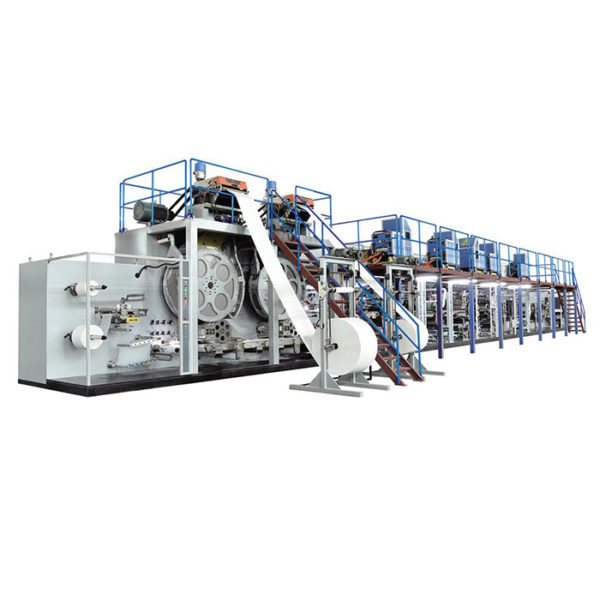
A monolithic diaper machine is conceived and built as a single, integrated unit. Every process—from the unwinding of nonwoven fabrics to the final bagging of the diapers—is part of one long, continuous chassis. Its advantage can be a lower initial cost and a potentially smaller footprint, as every component is tightly integrated. The disadvantage, however, is its rigidity. To increase its capacity, you often have to replace the entire machine. It is like buying a house with no possibility of adding an extension; if your family grows, you must move.
A modular design, by contrast, approaches the production line as a series of interconnected but independent stations or modules. You might have an unwinding module, a core-forming module, a chassis-cutting module, an elastic-application module, and a packaging module. Each is a self-contained unit that communicates with the others. The initial investment might be slightly higher, reflecting the more complex engineering of these independent units. The long-term strategic benefit is immense.
Consider the growth scenario. If your market demand doubles, you might not need to scrap your entire line. Instead, you could potentially add a second core-forming module and a higher-speed packaging unit, upgrading only the bottlenecks while retaining the rest of your initial investment. This approach offers staged, manageable capital expenditure that grows with your revenue. It also provides redundancy. If a critical component in a monolithic machine fails, the entire line stops. In a well-designed modular system, it might be possible to bypass a non-essential module or swap it out more quickly, reducing downtime. The choice between these two philosophies is a foundational one for any custom diaper machinery design.
| Характеристика | Monolithic Design | Modular Design |
|---|---|---|
| Initial Cost | Generally Lower | Generally Higher |
| Scalability | Low; often requires full replacement | High; upgrade specific modules |
| Гибкость | Low; difficult to add new features | High; can add new modules for new features |
| Footprint | Potentially smaller due to integration | Can be larger due to spacing between modules |
| Maintenance | Failure in one area can stop the entire line | Easier to isolate and service individual modules |
| Future-Proofing | Poor; locked into initial technology | Excellent; allows for phased technology upgrades |
Calculating ROI Based on Production Speed and Output
Return on Investment (ROI) is the ultimate arbiter of a business decision. For a diaper machine, the calculation seems straightforward on the surface: (Revenue – Cost) / Cost. The complexity, however, lies in accurately defining those variables over the machine's lifespan. Production speed, measured in pieces per minute (PPM), is a primary driver of the revenue side of the equation.
A machine running at 800 PPM will obviously generate more product than one running at 400 PPM. But speed is not free. Higher-speed machines involve more sophisticated engineering, higher precision components, and more robust control systems, all of which increase the initial capital outlay. They also consume more energy and may require more highly skilled operators. The correct approach is not to simply chase the highest possible speed but to find the optimal speed for your specific market and financial model.
Let us construct a simplified model. Assume a diaper sells for a net profit of $0.05 after material costs.
- Machine A (400 PPM): Produces 24,000 pieces/hour. At 20 hours/day, 300 days/year, that is 144 million pieces annually. Annual profit: 144,000,000 * $0.05 = $7.2 million.
- Machine B (800 PPM): Produces 48,000 pieces/hour. Using the same schedule, that is 288 million pieces annually. Annual profit: 288,000,000 * $0.05 = $14.4 million.
Machine B appears to be the clear winner. But now, let us factor in the cost. If Machine A costs $1.5 million and Machine B costs $3.5 million, the picture changes. We also need to add other operational costs: higher energy for Machine B, perhaps an extra higher-skilled technician. The true ROI calculation must be a projection over several years, incorporating the total cost of ownership (TCO), not just the sticker price.
Furthermore, the calculation must be stress-tested against your demand forecast. What if you can only sell 150 million diapers in year one? Machine A would be running near its capacity, likely at its most efficient point. Machine B would be running at half-speed, which can sometimes be inefficient and may not justify its higher capital cost in the short term. A proper custom diaper machinery design process involves working closely with the manufacturer to model these scenarios. They can provide data on the machine's efficiency curve at different speeds, helping you determine the sweet spot where capital cost, operational speed, and market demand harmoniously converge for the best possible ROI.
The Hidden Costs of Over- and Under-Capacity
The obvious cost of under-capacity is lost sales. When your brand is popular and shelves are empty because your diaper machine cannot keep up, you are not just losing revenue; you are creating an opening for a competitor to satisfy that demand. Customer loyalty can be fickle, once a consumer switches to another brand and has a positive experience, winning them back is an expensive proposition. Repeated stockouts can permanently damage a brand's reputation, making it seem unreliable in the eyes of both consumers and retail partners.
The costs of over-capacity are more subtle but can be just as corrosive. The most immediate cost is capital inefficiency. Money tied up in a machine that is larger and faster than necessary is money that could have been invested elsewhere—in marketing, in developing a complementary product line like a high-quality wet wipes production line, or in securing a better position in the raw material supply chain.
Then there are the operational costs. A large, high-speed machine running at a fraction of its capacity can be like driving a sports car in city traffic—it is inefficient. Motors, drives, and pneumatic systems are often designed for an optimal load and speed; operating far below that can lead to lower energy efficiency. There is also the physical space. A larger machine requires a larger factory floor, which translates to higher rent or construction costs, higher property taxes, and higher utility bills for lighting and climate control.
Perhaps the most insidious hidden cost is the psychological pressure to "feed the beast." When a management team sees a massive machine sitting idle or running slowly, there is a powerful temptation to produce inventory simply to keep it busy. This leads to bloated warehousing costs. Diapers are bulky; they consume a lot of space. Storing millions of excess units incurs expenses for the warehouse itself, for insurance, for climate control to prevent degradation, and for the labor to manage the inventory. This excess inventory also ties up cash and carries the risk of obsolescence if you decide to update your product design or packaging. A shrewd custom diaper machinery design process is therefore an exercise in risk management, carefully navigating the channel between the Scylla of lost sales and the Charybdis of idle, expensive capital.
Factor 2: Raw Material Compatibility and Waste Reduction
A diaper is a marvel of material science, a layered composite of polymers, cellulose, and synthetic fabrics, each chosen for a specific function. The diaper machine is the conductor that brings these materials together in a high-speed symphony of precision. The quality of the final product and the profitability of the operation are inextricably linked to how the machine interacts with these raw materials. A design that is forgiving of material variations and ruthlessly efficient in its use of them is not a luxury; it is a fundamental requirement for long-term success. The custom diaper machinery design process must therefore begin with a deep understanding of the materials themselves.
The Chemistry of Absorbency: SAP, Fluff Pulp, and Nonwovens
At the heart of every modern disposable diaper is the absorbent core. This is typically a blend of two key materials: fluff pulp and superabsorbent polymer (SAP). Understanding their properties is the first step to designing a machine that can handle them effectively.
Fluff pulp is a cellulose-based material, usually derived from softwood trees like pine. In its raw form, it comes in dense, rolled sheets. The first task of the diaper machine is to pass these sheets through a "hammermill," a high-speed rotary grinder that defibrates the pulp, turning it into a soft, cotton-like fluff. This fluff provides the structure of the core and is responsible for the initial acquisition and distribution of liquid. The design of the hammermill and the subsequent "drum forming" system—which uses a vacuum to lay the fluff down into a precise pad shape—is critical. The density and uniformity of this fluff pad directly impact the diaper's comfort and its ability to prevent leaks.
Superabsorbent Polymer (SAP) is the true workhorse of absorbency. These are typically sodium polyacrylate granules that have an astonishing property: they can absorb and retain many times their own weight in liquid, turning into a stable gel. A few grams of this powder can lock away hundreds of milliliters of fluid. In the machine, SAP is precisely metered and mixed with the fluff pulp as the core is being formed. The challenge here is precision. Too little SAP, the diaper will fail. Too much is a waste of a very expensive material. The custom diaper machinery design must include a dosing system—be it volumetric or gravimetric—that can deliver the exact amount of SAP, milligram by milligram, diaper by diaper, at speeds of over ten per second.
Surrounding the core are the nonwoven fabrics. These are engineered textiles made from polymers like polypropylene. They serve multiple functions. The "topsheet" is the layer that touches the baby's skin; it must be soft, feel dry, and allow liquid to pass through it quickly into the core. The "backsheet" is the outer layer; it must be waterproof to contain the liquid, yet modern backsheets are often "breathable," allowing water vapor to escape to improve skin health. There are also acquisition-distribution layers (ADL) that sit between the topsheet and the core to speed up fluid intake, and the nonwovens that form the leg cuffs and waistbands. Each of these materials has a specific weight, texture, and elasticity. The machine's unwinding stands, tension control systems, and guiding mechanisms must be designed to handle this variety of materials without stretching, tearing, or misaligning them.
Designing for Material Versatility and Supply Chain Resilience
No manufacturer operates in a vacuum. Your supply chains for fluff pulp, SAP, and nonwovens will be subject to price volatility, shipping delays, and variations in quality. A machine that is tuned to run only one specific grade of pulp from one specific supplier is a fragile machine. A resilient business needs a diaper machine designed for versatility.
What does this mean in practice? It starts with the unwinding and splicing systems. A well-designed machine should have automatic splicers. When one roll of nonwoven material is about to run out, the machine automatically splices the end of the old roll to the beginning of a new one at full production speed, without stopping. A versatile design allows the operator to easily adjust the tension controls and web guides to accommodate materials with slightly different thicknesses or widths from a new supplier.
In the core-forming section, versatility might mean having a hammermill and drum-forming system that can be adjusted to create cores of different densities or shapes. Perhaps a new, cheaper fluff pulp is available, but it has slightly different fiber characteristics. A flexible machine would allow technicians to fine-tune the mill's speed and the drum's vacuum pressure to achieve the desired core properties with this new material.
For SAP application, a gravimetric (weighing-based) dosing system is inherently more versatile than a volumetric (volume-based) one. The density of SAP granules can vary slightly from batch to batch or supplier to supplier. A volumetric system might dispense the same volume but a different weight, affecting performance. A gravimetric system ensures the correct weight of SAP is applied every time, regardless of density variations.
This design philosophy is a form of insurance. By investing in a custom diaper machinery design that can handle a wider "process window" for raw materials, you are giving your procurement team the flexibility to negotiate better prices, switch suppliers when one fails, and test new, innovative materials as they become available. In markets like Russia or parts of South America where logistical challenges can be significant, having the ability to source materials from multiple regional suppliers instead of relying on a single overseas source can be the difference between continuous production and costly shutdowns.
Advanced Waste Management Systems in Modern Machinery
In a high-speed manufacturing process, some waste is inevitable. The goal of a superior machine design is to minimize that waste and, where possible, reclaim it. Waste in a diaper factory is lost profit. It represents material you have paid for but cannot sell. A modern diaper machine attacks waste on several fronts.
First is start-up and shut-down waste. When a line starts, it takes a few moments for all the processes to synchronize perfectly. During this time, the products being made may not meet quality standards. An advanced control system can be programmed to minimize this ramp-up period, synchronizing all drives and material flows in the shortest possible time.
Second is splice waste. Even with an automatic splicer, there is a small section where the two rolls of material are joined. A sophisticated machine will have sensors that track this splice through the entire process. It will then activate a rejection gate to eject only the one or two diapers containing the splice, rather than a larger batch.
Third is process-related waste. This is the "trim" or "cut-off" material. For example, when the contoured shape of the diaper chassis is cut from a continuous web of nonwoven material, the leftover material is waste. Advanced custom diaper machinery design incorporates vacuum-based trim removal systems that immediately collect this waste. In some of the most sophisticated setups, this nonwoven trim can be sent to a re-pelletizing system and sold, or even re-used in other non-hygienic applications. Similarly, the fluff pulp dust generated in the hammermill is collected by powerful filter systems. Instead of just being vented outside, this dust can be collected, compressed into briquettes, and sold as a fuel source or used in other cellulose-based products.
Finally, there is quality-rejection waste. Modern machines are equipped with high-speed vision systems. These are cameras coupled with powerful image-processing software that inspect every single diaper. They check for defects like a missing leg cuff, a misplaced frontal tape, or an improperly formed core. If a defect is detected, the system sends a signal to a rejection mechanism that removes that specific diaper from the production stream. This prevents defective products from reaching the consumer, protecting your brand's reputation, while also providing valuable data. The system logs the type and frequency of defects, allowing operators to identify the root cause—perhaps a nozzle is slightly clogged or a blade is becoming dull—and fix it before it leads to a large amount of waste.
The Economic Impact of a 1% Reduction in Material Waste
The numbers involved in diaper manufacturing are so large that even small percentage improvements in efficiency can have a massive impact on the bottom line. Let us explore the economics of a seemingly tiny 1% reduction in material waste.
Assume a mid-sized diaper machine produces 200 million diapers per year. Also assume the total raw material cost for a single diaper is $0.10.
- Total annual raw material consumption cost: 200,000,000 diapers * $0.10/diaper = $20,000,000.
Now, let us say the machine, due to an older design or poor tuning, has a waste rate of 5%.
- Annual cost of waste: $20,000,000 * 5% = $1,000,000.
This one million dollars is the value of the pulp, SAP, and nonwovens that are purchased but end up in a dumpster or a reclamation system. It is a direct reduction from the company's gross profit.
Now, imagine you invest in a new custom diaper machinery design or an upgrade to your existing line that, through better tension control, more precise cutting, and an advanced quality rejection system, reduces the total waste rate from 5% to 4%. That is a 1% reduction.
- New annual cost of waste: $20,000,000 * 4% = $800,000.
- Annual savings: $1,000,000 – $800,000 = $200,000.
This $200,000 saving drops directly to the bottom line, increasing profitability every single year. Over a five-year period, that is a million dollars in savings. This additional profit could be enough to finance the development of a new product, fund a major marketing campaign, or purchase an additional piece of equipment, such as a machine for producing sanitary pads. The pursuit of waste reduction is not just an operational goal; it is a powerful financial strategy. When evaluating a proposal for a new diaper machine, the quoted waste percentage is not a minor technical detail; it is a key performance indicator that should be scrutinized, guaranteed by the supplier, and verified during the factory acceptance test.
Factor 3: TheSpectrum of Automation and Labor Considerations
The level of automation in a production line is one of the most significant decisions a manufacturer will make. It profoundly influences capital expenditure, operational costs, product quality, and workforce structure. There is no single "correct" level of automation; the optimal choice is a careful calculation based on the specific economic and social context of the manufacturing plant. For businesses in regions as diverse as Southeast Asia and Russia, this calculation will yield very different results. A custom diaper machinery design must therefore be a tailored response to the question: where on the spectrum of automation should this factory operate for maximum, sustainable success?
Fully Automated vs. Semi-Automated Lines: A Cost-Benefit Analysis
The choice between a fully automated and a semi-automated line is a classic trade-off between capital expense (CapEx) and operational expense (OpEx).
A fully automated line represents the pinnacle of current technology. On such a line, human intervention is minimal. Raw material rolls are often loaded by robotic arms. Automatic splicing is standard for all materials. The machine's parameters are controlled via a central Human-Machine Interface (HMI). Quality control is performed by vision systems. The final products are counted, stacked, and fed directly into an automatic bagging machine, which then passes the bags to a case packer and a palletizer. A small team of highly skilled technicians oversees the entire process, monitoring performance and intervening only when a fault occurs or a major changeover is required.
The primary benefit is consistency. A machine, unlike a person, does not get tired or distracted. It performs the same action with the same precision, millions of times. This leads to a highly consistent product quality and a very low rate of human-error-induced defects. Production speeds can also be much higher, as the line is not limited by the speed of manual packing. The main drawback is the immense initial investment. The robotics, advanced sensor systems, and complex software required for full automation are expensive. Maintenance also demands a higher level of technical expertise.
A semi-automated line, on the other hand, strategically replaces some of the most expensive automation with skilled human labor. The core production process—forming the diaper—is typically still automated for speed and precision. The difference often appears at the end of the line. Instead of an automated stacker and bagger, the machine might deposit the diapers onto a conveyor where a team of workers manually inspects, counts, and packs them into bags. Raw material rolls might be loaded manually instead of by robots.
The obvious advantage is a significantly lower initial CapEx. This can make entering the market far more accessible for a new business. It also creates local employment, which can be a positive factor in many communities. The disadvantages include lower maximum production speeds, as the line is ultimately paced by the manual packing team. There is also a higher potential for inconsistency and human error in the packing and final inspection process. The operational cost for labor will be higher year after year.
| Aspect | Semi-Automated Line | Fully Automated Line |
|---|---|---|
| Первоначальные инвестиции | Нижний | Очень высокий |
| Operational Labor Cost | Высокий | Low |
| Max Production Speed | Moderate (often limited by manual packing) | Очень высокий |
| Product Consistency | Good, but subject to human error | Excellent |
| Workforce Requirement | Larger team of operators/packers | Smaller team of skilled technicians |
| Flexibility for Small Batches | Can be more flexible | Less efficient for very small, varied runs |
| Suitability | Markets with lower labor costs; start-ups | Markets with high labor costs; large-scale producers |
The decision requires a careful financial model. In a country with high labor costs, the savings in OpEx from a fully automated line can pay back the higher initial CapEx in just a few years. In a country with a large, available workforce and lower wage rates, a semi-automated line might remain the more profitable option for a decade or more.
Integrating Robotics and AI for Quality Control
One of the most transformative applications of modern technology in manufacturing is the use of artificial intelligence (AI) and robotics for quality control. The traditional method of quality control involved operators periodically taking a diaper off the line and manually inspecting it. This "spot-checking" method is inherently flawed. At a speed of 600 diapers per minute (10 per second), an operator might inspect one diaper out of every thousand. What about the 999 in between?
Modern quality control is about 100% inspection. This is achieved through machine vision systems. Think of it as a team of tireless inspectors with superhuman eyes. High-resolution cameras are placed at critical points along the production line. One camera might look at the absorbent core just after it is formed to check for uniform density. Another might inspect the application of the leg elastics. A third might verify the correct placement of the landing zone for the fastening tapes.
These cameras capture thousands of images per minute. It is the AI-powered software behind them that provides the intelligence. The software is "trained" on what a perfect diaper looks like. It learns the acceptable range of variation for hundreds of features. During production, it compares every image to this ideal model in real-time. If it detects an anomaly—a spot of glue where it should not be, a misaligned topsheet, a tear in the backsheet—it instantly flags the diaper. It then does two things:
- It sends a signal to a rejection system to remove that single defective product from the line.
- It logs the fault. If it sees the same type of fault repeating, it can alert the operator or even, in the most advanced systems, attempt to self-correct the process. For example, if it detects the adhesive for the frontal tape is consistently being applied a millimeter too far to the left, it might slightly adjust the position of the adhesive nozzle.
This integration of AI provides a level of quality assurance that was previously unimaginable. It reduces waste, protects brand reputation, and provides a wealth of data that can be used for continuous process improvement. When discussing a custom diaper machinery design, inquiring about the sophistication of the vision system—its resolution, the number of inspection points, and the intelligence of its software—is a conversation about the fundamental quality of your future product.
Operator Skill Requirements and Training Programs
The machine, no matter how automated, is only as good as the people who run it. The level of automation you choose directly dictates the type of team you need to build.
A semi-automated line requires a larger number of operators, but the skill level for many of the positions, particularly in manual packing, may be lower. The key personnel are the machine minders and the line supervisors who understand the mechanical workings and can troubleshoot common problems. Training for these roles often focuses on operational safety, manual dexterity for packing, and basic visual inspection skills.
A fully automated line requires a much smaller team, but their skill requirements are significantly higher. You no longer need packers, but you desperately need technicians who are multi-talented. They need to be mechanically adept to handle physical repairs. They need to be proficient with electronics and sensor technology to diagnose a faulty photoelectric eye or proximity switch. They need to be comfortable with software, able to navigate the HMI, interpret error logs, and perhaps even make minor adjustments to the PLC (Programmable Logic Controller) code. These are not factory workers in the traditional sense; they are "mechatronics" technicians.
Finding, training, and retaining such talent can be a challenge, especially in regions where this level of industrial automation is new. This is where the role of the machinery supplier becomes vital. A reputable supplier does not just sell you a machine; they sell you a complete production solution. This includes a comprehensive training program. This program should not be a one-week afterthought. It should be a structured process that might include:
- Classroom training: Covering the theory of operation, the function of each module, and the software interface.
- Training at the supplier's facility: Your key technicians should be present during the final assembly and testing of your machine at the supplier's factory. They can learn alongside the engineers who built it.
- On-site training during installation: The supplier's engineers should remain on-site for several weeks after the machine is installed, working side-by-side with your team to run the machine, troubleshoot initial problems, and transfer knowledge.
- Ongoing support: The supplier should offer ongoing access to technical experts and potentially advanced refresher courses as new technologies emerge.
When choosing a supplier, the quality and depth of their training program are as important as the steel and wires of the machine itself.
The Role of Automation in Ensuring Consistent Product Quality
The ultimate goal of any manufacturing process is to produce a product that meets the customer's expectations every single time. A parent buying a pack of your diapers in Johannesburg should have the exact same positive experience as a parent buying the same pack in Moscow. Automation is the most powerful tool for achieving this level of consistency.
A human operator, however well-trained and diligent, is subject to variability. The way they stack diapers might vary slightly from the beginning of their shift to the end. Their attention might wander for a moment, causing them to miss a minor defect. The tension they apply when manually starting a new roll of material might differ each time.
An automated system eliminates this variability. A servomotor-driven applicator will place the elastic waistband with a precision of a fraction of a millimeter, over and over again. A gravimetric SAP doser will ensure each core has the exact same absorbent potential. An ultrasonic bonding unit will apply the same amount of energy for the same duration to create a perfect weld on every side seam.
This consistency has a cascading effect. It simplifies quality control because the process is inherently more stable. It reduces "in-process" waste caused by minor deviations accumulating into a major problem. It builds brand trust, as consumers learn that your product is reliable. It even simplifies the supply chain, as your retail partners know that every case of diapers they receive will contain the same number of perfectly packed, high-quality units.
While full automation requires a significant investment, the return is not just in labor savings. The return is in the establishment of a robust, predictable, and high-quality manufacturing operation that can compete on a global scale. The custom diaper machinery design process is an opportunity to build this consistency into the very DNA of your factory.
Factor 4: Customization for Product Differentiation
In a crowded marketplace, the ability to stand out is not just an advantage; it is a prerequisite for survival. Consumers are faced with a dizzying array of choices. Why should they choose your diaper? The answer often lies in the unique features and perceived value of the product itself. The diaper machine is the tool that enables this differentiation. A generic machine produces a generic diaper. A custom diaper machinery design, however, allows a manufacturer to engineer specific, desirable features into their product, creating a unique selling proposition (USP) that resonates with their target audience.
Engineering for Unique Diaper Features
The modern diaper is far more than just an absorbent pad. It is a highly engineered garment designed for comfort, performance, and convenience. The ability of your machine to create these features is what will set your brand apart.
Consider the elastic waistband. A simple, flat waistband is easy to produce. But a soft, wide, and highly elasticated waistband that provides a snug, comfortable 360-degree fit is a premium feature that parents value. To produce this, the machine needs a sophisticated lamination unit. This unit must take multiple layers of nonwoven material and several strands of elastic thread, control the tension of each strand precisely as it is being stretched, and then bond them together using adhesive or ultrasonic energy—all while running at hundreds of meters per minute.
Wetness indicators are another popular feature. This is a line of pH-sensitive ink printed on the backsheet that changes color when it comes into contact with urine. It is a simple, visual cue for parents. To incorporate this, the custom diaper machinery design must include a precision printing station. This is not just a simple ink roller; it must be a contact or non-contact (inkjet) system capable of applying a very thin, precise line of a specific chemical ink onto a fast-moving web of material without smudging or over-applying.
Other features that require specific engineering solutions include:
- Contoured leg cuffs (3D leak guards): These require special folding and bonding modules to create the standing gathers that prevent side leakage.
- Breathable backsheets: While the material itself is breathable, the machine must be able to handle these microporous films without damaging them, and the bonding process (adhesives) must not clog the pores.
- Lotion or aloe vera application: Some premium diapers feature a topsheet treated with a thin layer of lotion. This requires a specialized coating module with a precision spray or roller system that can apply a minute, uniform amount of lotion.
When you are defining your product, you are also defining your machine. Each desired feature translates into a specific engineering requirement, a module or a station on the production line. The discussion with your machine supplier should be a creative partnership, exploring the "art of the possible" and translating your brand vision into mechanical reality.
The Mechanics of Size Changeovers: Flexibility as a Feature
A diaper brand rarely sells just one size. A typical portfolio includes sizes ranging from newborn to toddler. Your factory must be able to produce all these sizes efficiently. The process of switching the machine from producing one size (e.g., Medium) to another (e.g., Large) is called a "size changeover." The speed and ease of this changeover are a critical, but often overlooked, feature of the machine's design.
A slow, cumbersome changeover is a major source of lost production. If it takes an entire eight-hour shift to change sizes, that is a full shift where no diapers are being produced, yet you are still paying for labor, electricity, and the overhead of the factory. A machine designed for rapid changeovers can minimize this downtime to as little as 30-60 minutes.
What enables a rapid changeover?
- Automation: In a highly automated machine, many adjustments are made through the HMI. The operator selects the "Large" size recipe from a menu, and dozens of servomotors automatically move components to their pre-programmed positions. Guides are widened, cutting knives are adjusted, and adhesive patterns are changed, all without an operator touching a wrench.
- Quick-Release Mechanisms: For parts that must be changed manually, such as the main cutting drum that determines the diaper's shape, a well-designed machine uses quick-release clamps, standardized fittings, and lightweight, ergonomic designs. Instead of an operator spending an hour unbolting a heavy component, they can release a few clamps and swap it with a pre-prepared part in minutes.
- Digital Readouts and Gauges: For manual adjustments, having digital readouts (e.g., "move guide to position 25.4 mm") is far faster and more accurate than relying on rulers and trial-and-error.
The ability to perform quick size changeovers gives a business tremendous agility. It allows you to produce smaller batches of each size more frequently, reducing the need for large inventories. If you see a sudden spike in demand for your newborn size, you can quickly switch production to meet that demand without disrupting your entire schedule. This flexibility is particularly important in volatile emerging markets. A custom diaper machinery design that prioritizes rapid changeovers is a design that prioritizes market responsiveness.
Integrating Packaging Solutions into the Production Line
The diaper is not sold until it is in a bag, the bag is in a case, and the case is on a pallet. The packaging process is an integral part of production, not an afterthought. Integrating packaging solutions directly into the diaper machine line creates a seamless, efficient flow from raw material to finished good.
The first stage is stacking and counting. As diapers exit the main machine, they need to be counted and arranged into neat stacks, ready for bagging. A simple machine might drop them onto a conveyor for manual counting. A more advanced machine uses a high-speed "stacker" with rotating paddles or a vacuum system to create perfect stacks of, say, 20 diapers.
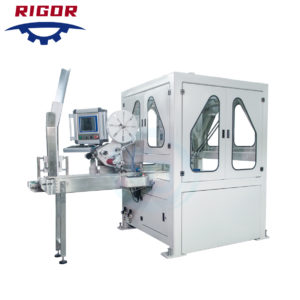
The next stage is bagging. The stacks are then transferred to a bagging machine. This can be a semi-automatic process where an operator holds a pre-made bag open for the machine to push the stack in. Or, it can be fully automatic. An automatic bagger takes a roll of printed plastic film, forms it into a bag, pushes the stack of diapers inside, seals the bag, and cuts it free. These machines can pack over 100 bags per minute. The integration is key; the bagger must "talk" to the diaper machine to ensure it is ready to receive each stack as it is produced. A well-integrated system might even use a buffer conveyor that can hold a few stacks temporarily if the bagger has a brief stop, preventing the entire line from shutting down. Many manufacturers also offer integrated solutions for other products, like a specialized wet wipe packaging machine, allowing for brand consistency across different product lines.
The final stage is case packing and palletizing. The sealed bags are then conveyed to a case packer, which automatically groups them and places them into cardboard boxes. These boxes are then sent to a robotic palletizer, which stacks them onto a pallet in a pre-programmed pattern, ready for a forklift to take them to the warehouse.
Integrating these systems provides enormous benefits in terms of labor savings, speed, and consistency. It also reduces the factory footprint by creating a compact, linear production flow. When commissioning a custom diaper machinery design, it is wise to consider the entire line, from pulp to pallet, as a single, integrated system.
Case Study: A Custom Design for a Niche Market
Let us imagine a hypothetical start-up in a coastal region of the Middle East. Their market research identifies a niche for an ultra-premium, "dermatologically-tested" diaper for high-income families. Their brand story is about ultimate skin comfort and protection in a hot, humid climate.
A generic diaper machine will not suffice. They partner with a supplier to create a custom diaper machinery design with specific features to support their brand promise:
- Specialized Topsheet Module: Instead of a standard polypropylene topsheet, they want to use a new, expensive nonwoven material infused with bamboo fibers for extra softness. The machine's unwinding and tension control systems are specifically calibrated for this delicate, low-stretch material.
- Lotion Application System: They incorporate a high-precision, non-contact spray system to apply a thin, uniform layer of calendula-infused lotion onto the topsheet. The system includes its own heating and viscosity controls to ensure the lotion is applied perfectly, even as the ambient factory temperature fluctuates.
- Maximum Breathability Design: The backsheet they choose is a state-of-the-art breathable film. The custom design ensures that the adhesive used to laminate the backsheet to the other layers is applied in a "net-spray" pattern, rather than a full coat. This maintains over 90% of the material's breathability, a key selling point.
- Enhanced SAP/Pulp Mixing: To combat rashes in humid climates, the core is designed for rapid fluid acquisition and dispersion. The machine's drum-forming section is engineered with a unique dual-chamber vacuum system and a specialized SAP applicator that creates a gradient of absorbency within the core, wicking moisture away from the skin faster.
This custom-designed machine costs more than an off-the-shelf model. However, it allows the company to produce a product that no competitor can easily replicate. They can command a higher price point, and their marketing can focus on tangible, demonstrable product benefits. The custom design is not an expense; it is the enabling technology behind their entire business strategy.
Factor 5: Long-Term Viability: Maintenance, Support, and Upgradability
The purchase of a diaper machine is not a transaction; it is the beginning of a long-term relationship. The machine is a complex asset that will be the heart of your factory for a decade or more. Its initial performance is important, but its long-term reliability, the cost to maintain it, and its ability to adapt to future needs are what will ultimately determine its true value. A forward-thinking buyer evaluates the supplier's commitment to the machine's entire lifecycle, from the day it is installed to the day it is decommissioned. A custom diaper machinery design should therefore include a plan for its own future.
The Importance of a Robust Spare Parts and Service Agreement
A production line running 24/7 at high speed is subject to wear and tear. Bearings will wear out, blades will become dull, motors will eventually fail. These are not signs of a bad machine; they are the realities of mechanical operation. The difference between a minor inconvenience and a catastrophic shutdown is the speed at which you can get the right spare part and, if needed, the right technical support.
A robust spare parts and service agreement, negotiated as part of the initial purchase, is your insurance policy against downtime. This agreement should clearly define several things:
- Список рекомендуемых запасных частей: The supplier should provide a detailed list of "critical" and "recommended" spare parts to keep on-site. Critical parts are those unique components whose failure would stop the line and which have a long lead time to acquire. Recommended parts are more common wear items. Having these on hand can turn a week of downtime into an hour of maintenance.
- Pricing and Availability: The agreement should lock in pricing for spare parts for a certain period and guarantee their availability. You do not want to discover two years after purchase that a critical part is no longer made or its price has tripled.
- Technical Support: How do you access support? Is there a 24/7 hotline? Is support available in your local language? What is the guaranteed response time for an email or a call? Can their technicians remotely access your machine's control system to help diagnose problems?
- Field Service: If a problem cannot be solved remotely, what is the process for getting a supplier's engineer to your factory? The agreement should specify the daily rate for a field service engineer and the guaranteed time it will take for them to arrive on-site, whether they are coming from a regional office or from headquarters overseas.
Evaluating a supplier's service and support infrastructure is as vital as evaluating their engineering prowess. Ask for references from other customers in your region. How has the supplier responded when their machine went down? Their answer will tell you a great deal about the partner you are choosing.
Remote Diagnostics and IoT-Enabled Predictive Maintenance
The traditional model of maintenance is "reactive." A part breaks, the machine stops, and you fix it. The next evolution was "preventive" maintenance. You replace parts on a fixed schedule (e.g., "replace all cutter blades every 500 hours of operation"), whether they are worn out or not. The most advanced approach, enabled by the Industrial Internet of Things (IIoT), is "predictive" maintenance.
In a modern custom diaper machinery design, the machine is studded with hundreds of sensors. These sensors do not just monitor the process; they monitor the health of the machine itself. They measure temperature, vibration, electrical current draw, and pressure. This data is continuously collected and analyzed.
Think of a large bearing on a main drive roller. In a healthy state, it has a specific vibration signature and operating temperature. As it begins to wear out, long before it fails, its vibration signature will change subtly, and its temperature may start to creep up. An IIoT system, often using machine learning algorithms, can detect this tiny deviation from the norm. It can then send an alert to the maintenance team: "Warning: Bearing on main drive roller C-7 shows a 15% increase in vibration. Estimated time to failure: 3 weeks. Please schedule replacement during the next planned maintenance window."
This is a paradigm shift. Instead of unscheduled, emergency downtime, maintenance becomes a planned, scheduled activity. You can order the part in advance and replace it during a time that causes minimal disruption to production. This maximizes uptime, reduces the need to hold a massive inventory of spare parts, and lowers overall maintenance costs.
Remote diagnostics is the other side of this coin. When a fault does occur that your team cannot solve, an IIoT-enabled machine allows a supplier's engineer, located thousands of miles away, to securely log into your machine's control system. They can "see" what the operator sees on the HMI, review alarm logs, analyze sensor data, and diagnose the problem as if they were standing right there. This can resolve issues in minutes that might have previously required a multi-day wait for an engineer to travel to your site.
Planning for Future Upgrades: Software and Hardware
The market does not stand still. New materials are developed, consumer preferences change, and new competitive pressures emerge. The diaper you produce in 2025 might not be competitive in 2030. Your machine must have a pathway to evolve. A key element of custom diaper machinery design is planning for future upgradability.
Software upgrades are the easiest path to new capabilities. The machine's functionality is governed by its PLC and HMI software. A well-designed software architecture allows the supplier to add new features or improve existing ones through a software update. This could be a new, more efficient algorithm for controlling adhesive application, a new recipe management system, or an improved diagnostic tool. When selecting a supplier, ask about their software development roadmap. Do they have a history of providing meaningful updates to their existing customers?
Hardware upgrades are more complex but should be part of the long-term plan. This is where a modular machine design shows its true value. Perhaps a new type of highly elastic side panel becomes popular. With a modular design, you might be able to purchase a new, self-contained module for applying these panels and integrate it into your existing line. This is far more cost-effective than replacing the entire machine.
The discussion about upgradability should be concrete. Ask the supplier:
- "If we wanted to add a lotion application system in two years, what would that entail? Is the frame pre-drilled for it? Does the control system have spare I/O capacity?"
- "If we need to increase our speed by 20% in three years, what would be the bottleneck, and what is the upgrade path for that specific module?"
A supplier who has thought through these scenarios and can provide clear, credible answers is a supplier who is planning for a long-term partnership, not just a short-term sale.
Evaluating Supplier Reputation and After-Sales Support
Ultimately, you are not just buying a machine; you are investing in the company that builds it. The supplier's reputation, financial stability, and corporate philosophy on customer support are intangible but immensely valuable assets.
How do you evaluate this?
- Talk to their customers. This is the most important due diligence you can do. Ask the supplier for a list of references—companies of a similar size to yours, preferably in your region. Call them. Ask them about their experience with the installation, training, machine reliability, and, most importantly, the supplier's response when things went wrong.
- Visit their factory. A factory visit tells you a lot about a company. Is it clean and well-organized? Do their engineers seem knowledgeable and passionate? What is their R&D facility like? Are they investing in new technologies? Do they manufacture key components in-house, or do they simply assemble parts from other vendors? In-house manufacturing of critical components often indicates a deeper level of expertise and better control over quality.
- Assess their global presence. For a customer in South America or the Middle East, a supplier with a regional office or a partnership with a local service agent is a huge advantage. It means faster access to spare parts and field service engineers who understand your local context.
- Review their financial health. A supplier who is financially unstable may not be around to support your machine in five years. While it can be difficult to assess a private company's finances, you can look for signs of stability: how long they have been in business, their recent growth, and their position in the market.
Choosing a machine supplier is like choosing a business partner. The technical specifications of the machine are the starting point, but the trust, communication, and long-term support offered by the supplier are what will ensure your investment continues to generate value for years to come.
Navigating the Supplier Selection Process
Armed with a deep understanding of the technical, operational, and strategic factors, the next step is the practical process of selecting the right supplier. This is a methodical journey of discovery, negotiation, and verification. It requires diligence and a clear vision of your project's goals. This process transforms your theoretical requirements into a tangible contract with a partner who will build the heart of your factory.
Crafting a Detailed Request for Proposal (RFP)
An RFP is the foundational document of your procurement process. It is not just a request for a price; it is a detailed description of your needs that allows suppliers to propose a thoughtful, relevant solution. A vague RFP will elicit vague, incomparable proposals. A detailed RFP will force suppliers to demonstrate their expertise and allow you to compare them on an "apples-to-apples" basis.
Your RFP should include several key sections:
- Project Overview: Briefly describe your company, your target market, and your business goals.
- Product Specifications: This is the most important section. Provide detailed drawings or descriptions of the diapers you intend to produce. Specify all sizes, dimensions, and target weights. List every feature you require (e.g., elastic waistband, 3D leak guards, wetness indicator).
- Raw Material Specifications: List the types of materials you plan to use (e.g., fluff pulp from a specific source, SAP with a certain absorbency rating, nonwoven fabrics with specific weights). Also, state the range of materials you want the machine to be able to handle to ensure versatility.
- Performance Requirements: Specify the required production speed (e.g., "a stable production speed of not less than 600 PPM for the Medium size"). Specify the maximum acceptable waste percentage (e.g., "total waste not to exceed 3%"). Specify the required efficiency rate (e.g., "overall equipment effectiveness (OEE) of not less than 85%"). And specify the maximum time for a size changeover.
- Scope of Supply: Clearly state what you expect the supplier to provide. Does it include just the diaper machine? Or does it also include the stacker, bagger, raw material handling systems, and dust collection systems?
- Training and Service Requirements: Detail your expectations for operator training, the recommended spare parts package, and the after-sales service agreement.
- Commercial Requirements: Specify your desired delivery timeline, payment terms, and the type of warranty you expect.
Distributing a detailed RFP to a shortlist of potential suppliers is the first step toward a professional and successful procurement project.
On-Site Audits and Factory Acceptance Tests (FAT)
Proposals and promises are one thing; physical reality is another. You must verify a supplier's claims. This involves two critical steps: the on-site audit and the Factory Acceptance Test (FAT).
The on-site audit is your visit to the supplier's manufacturing facility before you sign a contract. As mentioned earlier, this is your chance to assess their capabilities. But go beyond a simple tour. Ask to see a machine similar to the one you are ordering, preferably one that is currently being assembled or tested. Talk to their engineers. Scrutinize the quality of the machining, the neatness of the electrical wiring, and the overall organization of their operations. A culture of quality is visible in the details.
The Factory Acceptance Test (FAT) is perhaps the most important milestone before the machine is shipped. The FAT is a contractually obligated test run of your specific machine, conducted at the supplier's factory, with you and your technical team present. During the FAT, the supplier must demonstrate that the machine meets all the performance requirements laid out in the RFP and the contract.
You should come to the FAT prepared with a detailed checklist. The supplier should run the machine for an extended period (often 4-8 hours) using the exact raw materials you specified. During this run, you will verify:
- Production Speed: Does it consistently achieve the guaranteed PPM?
- Качество продукции: Are the diapers produced identical to your specifications? You should take samples and measure them precisely.
- Waste Rate: The total waste produced during the run is collected and weighed to verify it is below the guaranteed maximum.
- Functionality: Test every single function, including size changeovers, automatic splicing, and the vision system's ability to detect and reject seeded defects.
The FAT is your last chance to identify and rectify any problems while the machine is still in the hands of its creators. Any issues found during the FAT must be corrected by the supplier before you approve the machine for shipment. Do not rush this process. A thorough FAT is the best guarantee of a smooth installation and start-up at your own factory.
Understanding Total Cost of Ownership (TCO) Beyond the Sticker Price
The lowest-priced machine is rarely the cheapest one to own. A savvy investor looks beyond the initial purchase price and evaluates the Total Cost of Ownership (TCO) over the machine's expected lifespan (e.g., 10 years). TCO provides a far more accurate picture of the long-term financial impact of your investment.
Компоненты ТШО включают в себя:
- Initial Purchase Price (CapEx): The cost of the machine itself, including all integrated systems and delivery.
- Installation and Commissioning Costs: The cost of the supplier's engineers to install and start up the machine at your factory.
- Operational Costs (OpEx):
- Энергия: The machine's total power consumption. A more energy-efficient design can lead to huge savings over a decade.
- Труд: The number of operators and technicians required to run the line.
- Waste: The cost of wasted raw materials. A machine with a 1% lower waste rate saves a significant amount of money every year.
- Consumables: The cost of items that are consumed during production but are not part of the final product, such as certain lubricants or cleaning agents.
- Maintenance Costs:
- Запасные части: The cost of the spare parts you will consume over the machine's life. A machine built with higher quality, more durable components may have a higher initial price but lower long-term spare parts costs.
- Service: The cost of any service calls or support contracts.
- Downtime Costs: This is the cost of lost production when the machine is not running. A more reliable machine with better support will have a lower downtime cost.
When you receive proposals from different suppliers, you should create a spreadsheet to model the TCO for each option. You may find that a machine that is 20% more expensive to purchase actually has a 10% lower TCO over ten years due to its higher efficiency, lower waste, and greater reliability. This analytical approach moves the decision from one based on price to one based on value.
Часто задаваемые вопросы (FAQ)
1. How long does it take to build and deliver a custom diaper machine? The timeline can vary significantly based on the complexity of the machine and the supplier's production backlog. Generally, you can expect a period of 6 to 12 months from signing the contract to the machine being ready for the Factory Acceptance Test (FAT). This includes design finalization, procurement of components, assembly, and initial testing. Shipping and installation can add another 2 to 3 months.
2. What is the typical power consumption of a modern diaper machine? Power consumption depends on the machine's speed, width, and the specific technologies used. A mid-range machine (e.g., 500-600 PPM) might have a total installed power of around 300-400 kW. However, its actual running consumption will be lower, typically in the range of 150-250 kW. When requesting a proposal, always ask for the estimated average power consumption, not just the total installed power.
3. Can one machine produce both baby diapers and adult incontinence products? While some components and processes are similar, baby diapers and adult incontinence products have very different size ranges and structural requirements. It is generally not practical or efficient for a single machine to produce both. Manufacturers specialize their machines. A company looking to enter both markets would typically invest in a dedicated diaper machine and a separate adult diaper machine.
4. What are the most common points of failure on a diaper machine? Common issues often relate to high-wear components. These include the cutting blades and anvils that need regular sharpening or replacement, adhesive nozzles that can become clogged, and bearings in high-speed rotating sections. Many failures are also related to sensors—photoelectric eyes or proximity switches can get dirty or knocked out of alignment, causing the machine's control system to receive incorrect information. A good preventive maintenance program focuses on these areas.
5. How much factory space is required for a diaper production line? The footprint depends on the machine's configuration (monolithic vs. modular) and the extent of automation. A complete line, including the main diaper machine, stacker, bagger, and space for raw material staging and finished goods, can require a significant amount of space. A rough estimate for a medium-speed line would be a clear, linear space of about 80 meters long by 20 meters wide, with a ceiling height of at least 5 meters.
6. Is financing available for purchasing such expensive machinery? Yes, many machinery suppliers have partnerships with financial institutions or offer their own financing options. These can include leasing programs or long-term payment plans. Additionally, government-backed export-import banks in the supplier's country may offer favorable loan terms to encourage exports. It is always worthwhile to inquire about financing options early in the negotiation process.
7. What level of technical skill is needed to operate the machine? For a semi-automated line, operators need good mechanical aptitude and the ability to follow procedures carefully. For a fully automated line, you need higher-level technicians with "mechatronics" skills, combining knowledge of mechanics, electronics, and software. The supplier's training program is essential for bringing your team up to the required skill level.
Заключительные мысли
The acquisition of a diaper production line is an act of profound industrial creation. It is a commitment of capital, strategy, and vision toward building a lasting enterprise. The process, as we have seen, is one of deep inquiry, moving far beyond a simple comparison of speeds and prices. It is an exercise in understanding the intricate dance between market dynamics and mechanical engineering, between material science and financial modeling, between automation and human skill.
A successful investment is born from a holistic perspective. It is one that sees the machine not as an isolated piece of equipment, but as the dynamic center of a complex ecosystem encompassing supply chains, a skilled workforce, a discerning consumer base, and a long-term plan for growth and adaptation. The path from concept to production is demanding, yet by focusing on these fundamental pillars—aligning capacity with demand, mastering material efficiency, choosing the appropriate level of automation, designing for differentiation, and ensuring long-term viability—a prospective manufacturer can navigate the complexities with confidence. The ultimate goal is to forge a partnership with a supplier that results not just in a machine, but in a resilient and profitable manufacturing solution tailored for its unique place in the world.
Ссылки
Mahoney, A. J. (2022, October 25). An overlooked superpower: How to explain complex concepts. Medium. medium.com
Michie, C. (2020). The role of nonwoven materials in the development of disposable diapers. Textile Research Journal, 90(7-8), 934-947.
Popp, J., & Pető, K. (2020). The competitiveness of the forestry sector in the context of the bioeconomy. Forests, 11(8), 868. https://doi.org/10.3390/f11080868
Ronin, K. (2025, September 23). How to explain complicated concepts clearly and SIMPLY
Sari, D. P., & Pahl, G. (2021). The implementation of overall equipment effectiveness (OEE) for measuring the effectiveness of the diaper packing machine. IOP Conference Series: Materials Science and Engineering, 1010(1), 012049.
Schmitt, R., & Brecher, C. (2018). Industrial solutions for ad-hoc and flexible manufacturing. In Advances in production technology (pp. 3-23). Springer. https://doi.org/10.1007/978-3-319-99939-5_1
Science of People. (2022, November 2). How to explain things better (& make people understand). scienceofpeople.com
Wang, L., & Wang, G. (2019). Big data and predictive maintenance: A review. IEEE Access, 7, 67688-67703.
Yundu Filling Machine. (2025, March 26). The ultimate guide to wet wipes making machines. yundufillingmachine.com
Zohdi, T. I. (2019). A review of the mechanics, processing, and manufacturing of superabsorbent polymers. Journal of Polymer Science Part B: Polymer Physics, 57(21), 1435-1450. https://doi.org/10.1002/polb.24883