Özet
This analysis provides a comprehensive examination of the factors determining the diaper manufacturing machine price in the 2025 global market, with a specific focus on emerging economies in South America, Russia, Southeast Asia, the Middle East, and South Africa. The inquiry moves beyond a superficial listing of costs to explore the intricate relationship between capital investment and long-term operational viability. It delves into seven principal determinants: production capacity and speed, the degree of automation, technological sophistication of core components, product versatility, raw material handling and waste management, manufacturer reputation and after-sales support, and the strategic choice between new and pre-owned equipment. By dissecting each element, this document aims to equip prospective investors and established manufacturers with the nuanced understanding required to make an informed, strategic, and profitable investment. The objective is to illuminate the pathway from initial capital outlay to sustained profitability, framing the acquisition of a diaper machine not as a mere purchase, but as a foundational business decision with far-reaching economic and operational consequences.
Önemli Çıkarımlar
- Production speed is a primary driver of the diaper manufacturing machine price.
- Full automation significantly increases initial cost but reduces long-term labor expenses.
- Machine versatility for different product types affects the overall investment.
- Manufacturer reputation and after-sales support are invaluable, non-negotiable assets.
- New machines offer warranties and modern tech, while used machines lower initial capital.
- Efficient raw material handling and waste reduction systems directly impact profitability.
- Technological components, like servo motors, enhance precision and long-term value.
İçindekiler
- Factor 1: Production Capacity and Speed (The Engine of Your Output)
- Factor 2: The Spectrum of Automation (From Semi to Fully Automated Systems)
- Factor 3: Technological Sophistication and Core Components
- Factor 4: Product Type and Versatility (Baby Diapers, Adult Incontinence, or Sanitary Pads?)
- Factor 5: Raw Material Compatibility and Waste Management
- Factor 6: Manufacturer Reputation, Origin, and After-Sales Support
- Factor 7: New vs. Used Machinery: A Critical Financial Fork in the Road
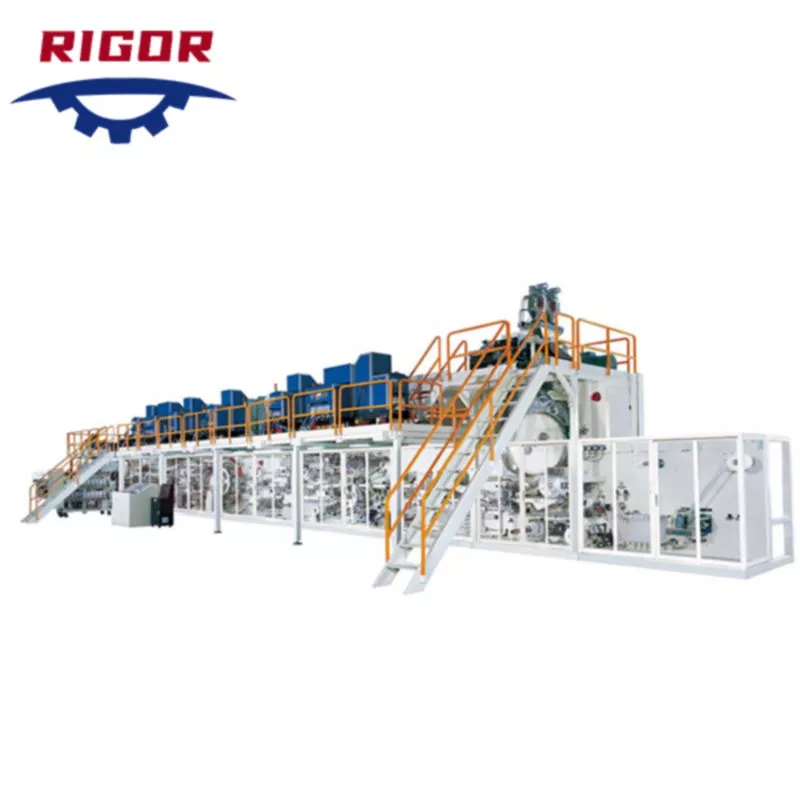
Factor 1: Production Capacity and Speed (The Engine of Your Output)
When one begins the journey of exploring an investment in the hygiene products sector, the initial questions often revolve around the tangible, the mechanical, the seemingly straightforward. Among these, the query of a machine's speed—its raw output—emerges as a primary concern. Yet, to treat production speed as a simple number on a specification sheet is to fundamentally misunderstand its profound implications for the entire business ecosystem. Production capacity is not merely a feature; it is the very heart of your manufacturing operation, the engine that dictates the rhythm of your supply chain, the scale of your market reach, and ultimately, the financial pulse of your enterprise. The determination of the right capacity is a delicate act of balancing ambition with pragmatism, a calculation that must account for market realities, capital constraints, and future growth trajectories. It is here, in this initial decision, that the foundation for either a thriving business or a struggling operation is laid. The diaper manufacturing machine price is inextricably linked to this metric, but the value derived from it extends far beyond the initial invoice.
Üretim Hızının Tanımlanması: Dakikada Parça (PPM)
In the lexicon of diaper manufacturing, speed is quantified in a simple yet powerful unit: Pieces Per Minute (PPPM). This figure represents the number of finished, ready-to-be-packaged diapers a machine can produce in sixty seconds. The range is vast. A basic, entry-level machine might operate at a modest 200-300 PPM. These are often the workhorses for startups or for businesses entering a niche, localized market where the demand does not yet justify a colossal output. As we ascend the scale, we encounter mid-range machines capable of 400-600 PPM. These represent a significant step up, suitable for businesses looking to capture a regional market share or serve larger private-label contracts. At the apex of the industry are the high-speed machines, marvels of modern engineering that can churn out 800, 1000, or even 1200+ PPM. These are the instruments of major national and multinational brands, designed for mass-market domination where economies of scale are paramount.
To contextualize these numbers, let us consider what they mean over an eight-hour shift. A 300 PPM machine will produce approximately 144,000 diapers. A 600 PPM machine, in the same timeframe, will produce 288,000 units. A 1000 PPM machine will yield a staggering 480,000 diapers. The difference is not just quantitative; it is strategic. The choice of PPM is a declaration of your business's intent and scale. It is a decision that must be made with a clear-eyed assessment of your target market's absorptive capacity. A machine that produces far more than the market can consume leads to idle capacity, bloated inventory, and wasted capital. Conversely, a machine that cannot keep up with demand results in lost sales, frustrated distributors, and an open invitation for competitors to fill the void. Therefore, understanding PPM is the first step in aligning your mechanical capacity with your economic reality.
The Economic Logic of Speed: Cost Per Unit
The relationship between production speed and the diaper manufacturing machine price is direct and exponential. Higher speed requires more sophisticated engineering, more robust materials, higher-precision motors, and more advanced control systems. The tolerances are tighter, the moving parts are more durable, and the entire chassis must be built to withstand the immense stresses of continuous, high-velocity operation. This is why a 1000 PPM machine does not simply cost twice as much as a 500 PPM machine; the price escalates more steeply due to the compounding complexity of the engineering involved. However, the true economic genius of speed lies not in the machine's price tag, but in its impact on the cost per individual diaper produced. This is a concept that every serious investor must internalize.
Let us imagine two factories. Factory A invests in a lower-speed machine, while Factory B invests in a high-speed machine. Both factories incur fixed overhead costs: rent, utilities, administrative salaries, and the amortization of the machine itself. For Factory A, these fixed costs are spread across a smaller number of units produced each day. For Factory B, the same category of costs is distributed over a much larger volume of diapers. The result is that the fixed cost allocated to each individual diaper is significantly lower for Factory B. This is the principle of economies of scale in its purest form. While Factory B's initial capital outlay was higher, its lower cost per unit gives it a formidable competitive advantage. It can price its products more aggressively to gain market share, or it can maintain market price and enjoy a healthier profit margin. This margin can then be reinvested into marketing, research and development, or further expansion. Speed, therefore, is not just about producing more; it is about producing more efficiently and, by extension, more profitably.
| Machine Tier | Üretim Hızı (PPM) | Estimated Price Range (USD) | Ideal Market Application |
|---|---|---|---|
| Entry-Level / Startup | 200 – 400 PPM | $250,000 – $600,000 | Local markets, niche products, startups |
| Mid-Range / Regional | 450 – 700 PPM | $600,000 – $1,500,000 | Regional distribution, private label manufacturing |
| High-End / National | 800 – 1200+ PPM | $1,500,000 – $5,000,000+ | National brands, export, mass-market dominance |
Matching Speed to Market Size: A Strategic Calculation
The critical task for an entrepreneur, especially in the diverse markets of South America, Southeast Asia, or Africa, is to perform a rigorous and honest market analysis before settling on a machine's capacity. This is not a task to be taken lightly or based on gut feeling. It requires data. How large is the target population? What is the birth rate? What is the current market penetration of disposable diapers? Who are the existing competitors, and what is their estimated market share and pricing strategy? What is the purchasing power of the average consumer? Answering these questions provides the necessary framework for a sound decision.
For instance, an investor targeting a specific, underserved urban center in Nigeria might find that a 350 PPM machine is perfectly adequate. It allows for a competitive entry into the market without the crushing financial burden of a high-speed line. The goal is to capture a loyal local following, build a brand, and then consider scaling up as distribution channels expand. In contrast, a company in Brazil aiming to compete with established national players would be ill-advised to enter with a low-capacity machine. To make any significant impact, they would need the production volume and cost efficiency that only a 600+ PPM machine can provide. The strategy must fit the context. In Russia, with its vast geography, a strategy might involve setting up multiple mid-range production hubs rather than one massive central factory. This approach could reduce logistical costs and improve delivery times, justifying the investment in several 500 PPM machines over one 1500 PPM giant. The key is to see the machine not as an isolated piece of equipment, but as a strategic tool whose specifications must be tuned to the specific economic and demographic landscape it is intended to serve.
Case Study: A Startup in Vietnam vs. an Established Brand in South Africa
Let us consider two hypothetical scenarios to bring this concept to life. First, a new startup in Vietnam, "An Binh Baby Care." Their market research indicates a growing middle class in Ho Chi Minh City with an increasing appetite for quality, locally-made products. However, brand loyalty to established Thai and Japanese brands is high. Their capital is limited. For An Binh, investing in an 800 PPM machine would be financial suicide. A more prudent path would be to acquire a 400 PPM machine. This allows them to produce enough volume to supply the city and its immediate surroundings. Their lower overhead allows them to price competitively, and their marketing can focus on the "proudly local" angle. Their diaper manufacturing machine price is manageable, and their risk is contained. They can focus on building their brand brick by brick.
Now, let us turn to "Cape Comfort," an established brand in South Africa that already has a 15% market share. They are currently operating two older 400 PPM machines. Their competitor has just upgraded to a new 1000 PPM line and is starting to undercut their prices. For Cape Comfort, standing still is not an option. They must invest to protect their market share and improve their margins. Their decision will likely be to decommission the older machines and invest in a new, state-of-the-art 1000 or 1200 PPM machine. The initial cost will be substantial, running into the millions of dollars. However, the resulting reduction in cost per unit will allow them to match their competitor's pricing, maintain their profitability, and secure their position in the market for the next decade. For them, the high price is not an expense; it is a necessary strategic investment in their own survival and future growth. These two cases illustrate that the "right" production speed is entirely relative to the strategic position and market context of the business making the investment.
Factor 2: The Spectrum of Automation (From Semi to Fully Automated Systems)
Once the fundamental question of production capacity has been addressed, the next critical frontier in determining the diaper manufacturing machine price is the level of automation. This is a domain where the interplay between upfront capital investment and long-term operational expenditure becomes most vivid. The choice of automation is not merely a technical one; it is a profound statement about a company's philosophy on labor, quality control, and operational efficiency. It reflects a strategic decision on where to allocate resources: to human hands or to robotic precision. Moving along the spectrum from semi-automatic to fully automatic systems involves a journey from higher reliance on manual intervention to a state of near-autonomous production. For business owners in regions with varying labor costs and skill levels, such as those in the Middle East or parts of Southeast Asia, this decision carries immense weight and requires a deep, nuanced analysis of the trade-offs involved.
Understanding the Levels: Manual, Semi-Automatic, and Fully Automatic
To navigate this decision, one must first grasp the distinctions between the levels of automation. At the most basic end, though increasingly rare for any serious commercial operation, would be a manual or near-manual process, which is not relevant for industrial-scale machinery. The practical spectrum begins with the semi-automatic diaper production line. In this configuration, certain key processes are automated—such as the formation of the absorbent core, the application of adhesives, and the cutting of the final product. However, human operators are still required for a number of crucial tasks. These might include loading raw material rolls onto the machine, manually splicing the end of one roll to the beginning of a new one, performing quality checks, and, most significantly, handling the packaging of the finished diapers. The machine produces the diapers, but they are then collected and bagged by a team of workers.
At the other end of the spectrum lies the fully automatic diaper machine. This is a far more complex and integrated system. Here, the goal is to minimize human intervention to the greatest extent possible. These machines often feature automatic splicing units that detect the end of a raw material roll and seamlessly join a new one without slowing down or stopping production. They incorporate advanced vision systems with high-speed cameras that inspect every single diaper for defects—such as improper placement of the frontal tape or leaks in the leg cuffs—and automatically reject any substandard units. Most critically, a fully automatic line integrates directly with an automated stacking and packaging machine. The finished diapers flow from the production unit to a stacker, which counts and arranges them, and then into a bagging machine that seals them into their final retail packaging, all without a human hand touching the product. The role of the operator shifts from active participant to that of a supervisor, monitoring the system's performance and intervening only when necessary.
The Labor Equation: How Automation Impacts Operational Costs
The most immediate and obvious consequence of choosing a higher level of automation is the impact on labor costs. A semi-automatic line, particularly one without an integrated packaging solution, might require a team of 8 to 12 workers per shift to manage the machine and handle the output. In a region where wages are relatively low, this might seem like a manageable expense. However, one must project these costs over the entire lifespan of the machine. Wages, benefits, and payroll taxes are a recurring operational expenditure that can rise over time. Furthermore, managing a larger workforce comes with its own set of complexities, including recruitment, training, scheduling, and potential labor disputes.
A fully automatic line, in stark contrast, might only require 2 to 4 highly skilled operators per shift. These individuals are typically technicians responsible for overseeing the complex system, performing maintenance, and troubleshooting any issues. While their individual salaries will be higher than those of the workers on a semi-automatic line, the total wage bill per shift is dramatically reduced. For a business operating in a market with higher labor costs, or one anticipating wage inflation, the economic case for full automation becomes overwhelmingly compelling. The higher upfront diaper manufacturing machine price is effectively an investment in future cost savings. It is a classic capital-for-labor substitution. Over a 5 or 10-year period, the cumulative savings on wages from a fully automatic line can easily surpass the initial price difference compared to its semi-automatic counterpart. This calculation is a cornerstone of any robust business plan for a diaper manufacturing venture.
| Özellik | Semi-Automatic System | Fully Automatic System |
|---|---|---|
| Initial Investment | Lower | Significantly Higher |
| Labor Requirement (per shift) | 8 – 12+ Operators | 2 – 4 Technicians |
| Operational Cost (Labor) | High and Recurring | Low and Stable |
| Production Consistency | Değişken, operatör becerisine bağlı | Extremely High and Uniform |
| Waste Rate | Higher (due to manual splicing, human error) | Lower (due to auto-splicing, auto-rejection) |
| Paketleme | Typically manual, separate process | Integrated, automated stacking and bagging |
| Ideal For | Markets with low labor costs, startups with limited capital | Markets with high labor costs, large-scale operations focused on efficiency and quality |
Quality and Consistency: The Unseen Benefits of Automation
Beyond the stark numbers of the labor equation lies a more subtle, yet equally critical, benefit of automation: product quality and consistency. Human beings, no matter how well-trained or diligent, are prone to fatigue and variability. On a semi-automatic line, the quality of the finished product can fluctuate depending on the skill and attentiveness of the operators on a given shift. A manual splice of a new material roll might be imperfect, leading to a series of defective diapers. A tired worker might mis-pack a bag, leading to customer complaints. These small inconsistencies, when multiplied over millions of units, can erode brand reputation and consumer trust.
A fully automatic system, by its very nature, eliminates this human variability from the core production process. The automatic splicing unit performs a perfect splice every time. The vision inspection system is relentless, examining products at a speed and with a precision that the human eye cannot match. It does not get tired. It does not have a bad day. Every diaper that passes inspection and goes into a bag is virtually identical to the one before it and the one after it. This unwavering consistency is a powerful marketing tool. It builds consumer confidence and justifies a premium price point. In a competitive market, where consumers have many choices, the assurance of consistent quality can be the deciding factor that fosters brand loyalty. This "hidden" value of automation—the value of guaranteed quality—is a major contributor to the higher diaper manufacturing machine price of these advanced systems.
The Upfront Investment vs. Long-Term Savings Dilemma
Ultimately, the decision comes down to a classic business dilemma: the trade-off between upfront capital and long-term operational savings. A fully automatic bebek bezi makinesi can cost hundreds of thousands, or even millions, of dollars more than a comparable semi-automatic model. For a startup with limited access to capital, this higher price may simply be prohibitive, making the semi-automatic route the only viable option. In this case, the business plan must be built around managing higher labor costs and implementing rigorous manual quality control procedures.
However, for a well-capitalized company or an established player looking to upgrade, the analysis must be more forward-looking. The question is not "Can we afford the fully automatic machine?" but rather "Can we afford not to?" The investor must calculate the payback period for the additional investment. By projecting the annual savings in labor costs and the reduction in waste material (due to features like auto-splicing and auto-rejection), one can determine how many years it will take for the machine to "pay for" its higher price. In many cases, especially in markets where wages are not negligible, this payback period can be surprisingly short, often between three to five years. After this point, the machine continues to generate those savings year after year, directly boosting the company's bottom line. The choice, therefore, is a strategic one, deeply rooted in the financial realities and long-term vision of the enterprise.
Factor 3: Technological Sophistication and Core Components
As we venture deeper into the anatomy of a diaper machine, we move from the macro-level considerations of speed and automation to the micro-level examination of its constituent parts. It is here, within the intricate assembly of gears, motors, sensors, and applicators, that the true character and capability of the machine are forged. The diaper manufacturing machine price is profoundly influenced by the quality and sophistication of these core components. To the untrained eye, two machines might appear similar in function, yet one may cost twice as much as the other. The difference often lies in the unseen technological choices made by the manufacturer—choices that have a direct and lasting impact on the machine's precision, reliability, efficiency, and lifespan. Understanding these technological nuances is akin to a prospective car buyer looking beyond the shiny paint job to scrutinize the engine, transmission, and suspension. It is an inquiry into the very soul of the machine.
The Heart of the Machine: Fluff Core Formers and SAP Applicators
At the very center of any disposable diaper is the absorbent core. This is the functional heart of the product, responsible for capturing and locking away moisture. The formation of this core is one of the most critical processes in the entire manufacturing line. The core is typically a mixture of fluffed wood pulp and Super Absorbent Polymer (SAP), a miraculous material that can absorb many times its own weight in liquid. The machinery responsible for creating this core is a primary determinant of both diaper quality and machine cost.
Entry-level machines may use a simpler, single-drum forming unit. This system lays down a basic, uniform pad of fluff pulp and SAP. While functional, it offers little flexibility in design. More advanced and expensive machines, however, feature sophisticated dual or even triple-drum forming units. These systems allow for the creation of a "contoured" or "profiled" core. This means the machine can strategically place more absorbent material where it is needed most (e.g., in the center of the diaper) and less where it is not (e.g., on the sides). This not only results in a more effective and comfortable diaper for the baby but also optimizes the use of raw materials. By using less fluff pulp and SAP overall without compromising performance, the manufacturer saves money on every single diaper produced. Furthermore, the precision of the SAP applicator is paramount. A basic system might simply sprinkle SAP onto the fluff pulp, leading to inconsistent distribution. A high-end machine will use a volumetric or gravimetric SAP application system, which measures out the precise amount of polymer required for each core and distributes it with exceptional uniformity. This precision reduces material waste and ensures that every diaper performs to the same high standard. The engineering complexity of these advanced forming and application systems is a significant contributor to the higher price of top-tier machines.
Precision Engineering: Tension Control, Web Guiding, and Splicing Units
A diaper is not a single entity but a laminate of multiple layers of different materials: the non-woven topsheet, the acquisition-distribution layer (ADL), the absorbent core, the polyethylene backsheet, and the elastic strands for the leg cuffs and waistband. These materials, which come on large rolls (or "webs"), must be unwound and brought together with microscopic precision while the machine is running at incredibly high speeds. The systems that manage this delicate ballet are a hallmark of a well-engineered machine.
Gerginlik Kontrolü: Each material has different properties and must be held under a specific, constant tension. If the tension is too loose, the material can wrinkle or misalign. If it is too tight, it can stretch or even break, causing the entire line to shut down. Basic machines may use simple mechanical brakes for tension control, which require frequent manual adjustment. Advanced machines, in contrast, use fully automated, closed-loop tension control systems with load cells and servo motors. These systems constantly measure the tension of each web and make micro-adjustments in real-time to keep it perfect, regardless of the roll diameter or machine speed. This drastically reduces material-related machine stops and improves product consistency.
Web Guiding: Similarly, each layer must be perfectly aligned with the others. Even a millimeter of misalignment can result in a defective diaper. Web guiding systems use sensors (often optical or ultrasonic) to monitor the edge of each material web and automatically adjust the roll's position to ensure perfect alignment. The responsiveness and accuracy of these guiding systems are critical, especially on high-speed machines where there is no room for error.
Splicing Units: As discussed under automation, the ability to join a new roll of material to an expiring one is crucial for efficiency. The difference in price is often in the sophistication of this unit. A "zero-speed" splicer, found on some mid-range machines, slows the line down momentarily to make the splice, creating a small disruption in production. A "flying" or "zero-tail" splicer, the standard on high-end machines, performs the splice at full production speed, with no slowdown and no wasted material at the join. This feature alone can significantly boost the overall equipment effectiveness (OEE) of the production line.
The Role of Servo Motors vs. Traditional Mechanical Drives
One of the most significant technological shifts in diaper machine design over the past two decades has been the transition from traditional mechanical drives to full servo motor control. In an older, mechanically-driven machine, a single large motor drives a complex system of gears, shafts, and belts that power all the different sections of the machine. The timing and relationship between these sections are fixed by the mechanical linkages. This design is robust but inflexible. Changing the size of the diaper, for example, might require a lengthy process of physically changing gears and making mechanical adjustments.
A modern, servo-driven machine represents a paradigm shift. Instead of one large motor, it uses dozens of smaller, independent servo motors, each one controlling a specific function (e.g., one servo for the knife that cuts the leg elastics, another for the applicator that places the frontal tape). All these motors are controlled and synchronized electronically by a central computer, the Programmable Logic Controller (PLC). This offers immense advantages. Size changes can be performed quickly, often by simply selecting a new recipe on the control panel, which dramatically reduces downtime. The electronic control allows for much finer adjustments and greater precision, leading to higher quality and less waste. Servo motors are also more energy-efficient than a large, continuously running main motor. While the initial diaper manufacturing machine price for a full-servo machine is substantially higher due to the cost of the motors and the complexity of the control system, the benefits in terms of flexibility, precision, efficiency, and reduced downtime provide a compelling return on investment for any serious manufacturer.
User Interface and Control Systems (PLC)
The brain of the modern diaper machine is its Programmable Logic Controller (PLC) and Human-Machine Interface (HMI). The PLC is the industrial computer that runs the machine, while the HMI is the touchscreen panel through which the operators interact with it. The sophistication of this system is a key factor in the machine's price and usability. A basic system might have a simple interface with limited diagnostic capabilities. When a problem occurs, it might only show a generic "fault" light, leaving the operator to hunt for the source of the issue.
A state-of-the-art HMI, on the other hand, provides a rich, graphical representation of the entire machine. It displays real-time data on production speed, material consumption, and efficiency. When a fault occurs, it pinpoints the exact location of the problem on the screen (e.g., "Sensor blocked at leg cuff applicator") and often suggests a solution, dramatically reducing troubleshooting time. These advanced systems also allow for remote diagnostics, where a technician from the machine manufacturer can log into the machine from anywhere in the world to help diagnose and resolve issues. They can store production data for analysis, track trends, and help management make informed decisions to optimize the production process. The investment in a high-quality PLC and HMI from a reputable brand (like Siemens or Allen-Bradley) is an investment in reliability, uptime, and operational intelligence.
Factor 4: Product Type and Versatility (Baby Diapers, Adult Incontinence, or Sanitary Pads?)
The world of absorbent hygiene products is not monolithic. While the baby diaper is the most prominent product, it is part of a larger family that includes adult incontinence products, sanitary pads (napkins), and training pants (pull-ups). A prospective investor's strategic vision regarding the breadth of their product portfolio has a direct and significant bearing on the type of machinery required and, consequently, on the capital investment. The decision is not simply about what to produce today, but also about what one might wish to produce tomorrow. The choice lies on a spectrum between a highly specialized, single-purpose machine and a more versatile, multi-product platform. Each path has its own economic logic and its own implications for the diaper manufacturing machine price.
The Anatomy of Different Products: Design and Material Variances
To appreciate the challenge of versatility, one must first understand that while these products share common principles (an absorbent core, a liquid-permeable topsheet, and a liquid-impermeable backsheet), their specific construction can differ markedly. A baby diaper is engineered for a specific range of body shapes and fluid volumes. A sanitary pad is a much smaller, thinner product, with a different shape, and often features "wings" for secure attachment. Its absorbent core is designed for a different type of fluid viscosity. An adult incontinence product, on the other hand, can be much larger than a baby diaper, requiring a significantly more substantial absorbent core and a more robust chassis to handle the higher pressures and volumes involved. Pull-up style training pants add another layer of complexity, requiring the creation of stretchable side panels and a 360-degree waistband, a fundamentally different construction process from an open-style "T-shape" diaper.
These differences in size, shape, and components necessitate different mechanical actions. The cutting dies that shape the final product must be different. The applicators for elastics need to be positioned differently. The folding and sealing mechanisms for a sanitary pad are entirely distinct from those for a full-sized adult diaper. A machine designed exclusively for one product can be optimized to perform its specific set of tasks with maximum speed and efficiency. Its parts are purpose-built and finely tuned for a single mission.
The Cost of Flexibility: Multi-Product vs. Single-Product Machines
This brings us to the core of the investment decision. A manufacturer can choose to purchase a dedicated machine for each product type they wish to produce. For instance, they might buy a dedicated baby diaper machine and a separate, dedicated hijyenik ped makinesi. This approach offers the highest possible efficiency and speed for each product line. The machines are always running, optimized for their task, with no downtime for changeovers. This is often the preferred strategy for very large-scale manufacturers who have sufficient demand for each product category to justify dedicated lines.
However, for a startup or a company testing new market segments, investing in multiple dedicated machines may be financially unfeasible. This is where the concept of a versatile or "convertible" machine comes into play. These machines are engineered with the flexibility to produce more than one type of product. For example, a machine might be designed to produce both baby diapers and certain types of adult incontinence briefs. Another might be capable of switching between sanitary pads and panty liners. This versatility is achieved through the use of interchangeable parts and modular design. The machine will come with different sets of cutting dies, forming units, and application modules. The control system (PLC) will have pre-programmed "recipes" for each product. The initial diaper manufacturing machine price for such a versatile machine will be higher than that of a single-purpose machine of similar speed. The extra cost accounts for the additional engineering, the extra sets of change parts, and the more complex control system required to manage the different configurations. However, this higher initial cost is often significantly lower than the cost of buying two separate, dedicated machines.
Changeover Times and Their Impact on Profitability
The primary trade-off for the benefit of versatility is the reality of "changeover time." When a manufacturer wants to switch production from, say, medium-sized baby diapers to small-sized adult diapers on a convertible machine, the line must be stopped. Technicians must then physically enter the machine and swap out the necessary components: the main cutting unit, the elastic applicators, perhaps parts of the core former, and so on. They must then load the new raw materials and recalibrate the machine's settings. This process can take anywhere from a few hours to a full shift, depending on the complexity of the changeover and the skill of the crew. During this entire time, the machine is not producing anything. It is idle, yet it continues to incur overhead costs.
Therefore, the economic viability of a versatile machine depends heavily on the production schedule. If a company plans to produce baby diapers for three weeks and then switch to adult diapers for one week, the downtime for one changeover per month may be perfectly acceptable. The flexibility to serve two different markets with a single machine outweighs the cost of the periodic downtime. However, if the market demands frequent changes between products—for example, switching every other day—then a versatile machine becomes highly inefficient. The cumulative downtime would cripple profitability. In such a scenario, investing in two dedicated machines, despite the higher upfront capital cost, would be the more sound long-term decision. The investor must carefully model their expected production runs and calculate the true cost of this non-productive time when evaluating the price of a flexible machine.
A Look into Specialized Requirements
The strategic decision to enter a specific product niche, such as sanitary pads or adult incontinence products, requires a deep appreciation for the specialized machine features that drive success in that segment. For a sanitary pad machine, for example, precision is everything. The application of the adhesive for the wings, the embossing of channels on the topsheet, and the individual wrapping and sealing of each pad must be flawless. Machines in this category are often judged on their ability to handle very thin materials without tearing and to produce a neat, aesthetically pleasing final package, which is critical for consumer appeal. For adult incontinence products, the focus shifts to power and robustness. The machine must be able to handle wider, thicker materials and form a much larger and denser absorbent core. The elastication systems for the leg cuffs and waistband must be powerful enough to ensure a secure and leak-proof fit on an adult. The choice to enter these markets means scrutinizing machine specifications that go beyond simple speed and automation, focusing on the nuanced capabilities that define product quality in that specific category. This specialization, naturally, is reflected in the machine's price. A machine capable of producing high-performance, multi-layered adult briefs will be a more significant investment than a simpler machine for basic sanitary pads.
Factor 5: Raw Material Compatibility and Waste Management
In the intricate calculus of diaper manufacturing, the machine itself, for all its mechanical complexity, is only one half of the production equation. The other half is the constant stream of raw materials that it consumes: the non-woven fabrics, the fluff pulp, the Super Absorbent Polymer, the polyethylene films, the adhesives, and the elastics. A machine does not operate in a vacuum; it exists in a dynamic relationship with these materials. Therefore, a truly insightful evaluation of a diaper manufacturing machine's value—and its price—must extend to its ability to handle a diverse range of raw materials efficiently and to minimize the waste generated in the process. This is a domain where engineering design has a direct and immediate impact on the daily operational costs and, by extension, the long-term profitability of the entire venture. A machine that is "forgiving" with its materials and "frugal" with its waste is an asset whose value grows with every production run.
Designing for Diverse Materials: Non-wovens, SAP, Fluff Pulp
The global supply chain for hygiene product raw materials is complex and subject to price fluctuations and variations in quality. A manufacturer in South America might have access to excellent, cost-effective fluff pulp from local sources, while a producer in the Middle East might find it more economical to import non-woven fabrics from Asia. The materials available today might not be the most cost-effective or highest-quality option available tomorrow. A savvy business must maintain the flexibility to adapt its sourcing strategy to these changing market dynamics.
This is where the design of the diaper machine becomes critically important. A machine built with very tight tolerances, optimized for a single, specific grade of non-woven fabric from a particular supplier, might run with incredible efficiency—as long as that specific material is used. However, if the manufacturer is forced to switch to a slightly thicker or rougher material from a different supplier, that same machine might begin to experience problems: material breaks, sensor misreads, and increased downtime. In contrast, a more robustly designed machine, often carrying a higher price tag, is engineered with a wider operating window. Its tension control systems, web guides, and sensors are designed to be more adaptable. It can handle a broader range of material thicknesses, textures, and properties without requiring extensive recalibration. This "forgiveness" in the machine's design is a form of insurance. It grants the manufacturer the freedom to chase material cost savings, to switch suppliers for better quality, or to navigate supply chain disruptions without grinding production to a halt. The higher initial investment in such a machine is an investment in supply chain resilience and long-term cost management.
The Hidden Cost of Inefficiency: Waste Reduction Systems
In an ideal world, every gram of raw material that enters the machine would exit as part of a saleable, finished diaper. In reality, some level of waste is unavoidable. There is trim waste from cutting the leg contours, startup and shutdown waste, and waste from rejected products. The goal of a well-designed machine is to reduce this waste to the absolute minimum, as every bit of wasted material is literally money being thrown away. The diaper manufacturing machine price is often a reflection of the sophistication of its waste-handling and reduction systems.
Consider the absorbent core. The process of forming the fluff pulp pad generates a significant amount of dust and loose fibers. A basic machine might simply vent this dust away to be collected as waste. A more advanced machine, however, will have an integrated pulp reclamation system. This system captures the excess pulp, filters it, and feeds it back into the beginning of the forming process. While this adds complexity and cost to the machine, it can reduce fluff pulp consumption by a meaningful percentage. Given that fluff pulp is one of the most significant raw material costs, the savings generated by such a system over a year of operation can be substantial. Similarly, as previously mentioned, features like zero-tail automatic splicers eliminate the waste associated with the end of each material roll. Advanced vision inspection systems that reject individual defective products, rather than allowing a whole series of bad products to be made before an operator notices, also play a crucial role in waste reduction. When evaluating a machine, an investor must ask not just "How fast does it run?" but "How efficiently does it use my expensive raw materials?"
How Machine Design Influences Material Sourcing Flexibility
Let's imagine a practical scenario. A diaper manufacturer in Russia has secured a large contract, but their usual European supplier of non-woven topsheet material is experiencing a production delay. They find an alternative supplier in China who can deliver the material quickly, but its specifications are slightly different—it's 2% thicker and has a different surface texture. With a lower-end, less flexible machine, this could be a crisis. The new material might cause jams in the folding section or trigger false readings from the optical sensors, leading to hours or even days of frustrating adjustments and lost production time. The cost of this downtime could easily wipe out any savings from the cheaper material.
Now, consider the same scenario with a higher-end machine designed for material flexibility. Its more advanced tension control system automatically compensates for the different properties of the new material. The operator might need to make a few simple adjustments via the HMI touchscreen, selecting a pre-programmed recipe for thicker materials. Within an hour, the machine is running smoothly with the new supply. The manufacturer has successfully navigated a potential supply chain crisis, fulfilled their contract, and maintained their profitability. This ability to adapt, which is a direct result of the machine's underlying engineering and a key justification for its higher price, is an invaluable strategic advantage in the volatile global market.
The Ecological and Economic Imperative of Reducing Waste
The conversation around waste reduction is not purely economic; it is also increasingly ecological. In markets around the world, there is a growing consumer and regulatory focus on sustainability. A manufacturing process that is visibly wasteful can become a liability for a brand's reputation. Companies are increasingly being called upon to report on their environmental footprint. A machine that is inherently designed to minimize waste is not just an economic tool but also a corporate social responsibility asset. It allows a company to build a brand narrative around efficiency and environmental stewardship, which can be a powerful differentiator, particularly among environmentally conscious consumers in urban centers across Southeast Asia, South America, and beyond.
Furthermore, the disposal of industrial waste itself is often a direct cost. Landfill fees and waste transport costs can add up. By minimizing the volume of scrap material generated, the machine directly reduces these associated disposal costs. Thus, the economic and ecological imperatives are perfectly aligned. The investment in sophisticated waste reduction systems—from pulp reclamation to vision-based quality control—pays a dual dividend: it lowers direct operational costs while simultaneously enhancing the brand's green credentials. This dual benefit is a powerful argument in favor of choosing a machine where efficiency and waste reduction have been treated as core design principles, not as afterthoughts.
Factor 6: Manufacturer Reputation, Origin, and After-Sales Support
The acquisition of a diaper manufacturing machine is not a simple transaction; it is the beginning of a long-term relationship. The machine is a complex piece of industrial equipment that will be the backbone of your business for a decade or more. Its performance, reliability, and lifespan are inextricably linked to the competence, integrity, and commitment of the company that built it. Therefore, when assessing the diaper manufacturing machine price, a significant portion of that price must be understood as an investment in the manufacturer themselves. The reputation of the builder, the geographical origin of the machine, and the quality and accessibility of their after-sales support are not soft, intangible factors. They are hard, critical components of the total value proposition, and ignoring them in favor of a lower upfront cost is one of the most perilous mistakes a new investor can make.
The Geographic Factor: Comparing Machines from Asia, Europe, and the Americas
Diaper manufacturing machinery is produced in several key industrial hubs around the world, each with its own general reputation and characteristics. European manufacturers, particularly from Italy and Germany, have a long-standing reputation for producing machines of the highest engineering quality, precision, and technological sophistication. These machines are often considered the "gold standard" in the industry, known for their reliability, high speeds, and longevity. Naturally, they also command the highest prices. For a multinational corporation or a market leader for whom maximum OEE (Overall Equipment Effectiveness) and cutting-edge features are paramount, a European machine is often the default choice.
In contrast, manufacturers from Asia, particularly from China, have emerged as formidable players in the global market. As highlighted by platforms like Made-in-China.com, Chinese manufacturers offer a very wide spectrum of machinery, from basic, low-cost, semi-automatic models to increasingly sophisticated, full-servo, high-speed lines. The primary advantage offered by Chinese manufacturers is a significantly more competitive diaper manufacturing machine price. This has made entering the diaper business accessible to a much broader range of entrepreneurs worldwide, especially in emerging markets. While in the past there may have been concerns about quality, leading Chinese manufacturers have made enormous strides in recent years, adopting advanced technologies and improving their build quality. A prospective buyer must engage in careful due diligence, as the quality can vary significantly from one manufacturer to another. A reliable bebek bezi makinesi üreticisi will be transparent about their components, offer client testimonials, and welcome factory visits. The choice between a top-tier European machine and a high-quality Chinese machine often comes down to a strategic calculation of capital cost versus perceived risk and long-term performance.
The Value of a Trusted Partner: Installation, Training, and Warranties
The price of a new machine should always include a comprehensive package of after-sales services. The machine does not simply arrive in a crate and start working. The first critical service is installation and commissioning. The manufacturer should send a team of skilled technicians to your factory to properly assemble, install, and fine-tune the machine. This is a complex process that ensures the machine is level, correctly powered, and calibrated to run optimally from day one. An improper installation can lead to chronic performance issues and premature wear and tear.
Following installation is operator training. The manufacturer's technicians should provide intensive, hands-on training to your local staff. This training should cover not only the day-to-day operation of the machine but also routine maintenance procedures, troubleshooting common faults, and performing product size changes. A well-trained team is your first line of defense against costly downtime. They will be able to run the machine efficiently and solve minor problems without needing to call for external support. The quality and thoroughness of this training are invaluable.
Finally, there is the warranty. A reputable manufacturer will stand behind their product with a comprehensive warranty, typically for one or two years. This warranty covers defects in materials and workmanship and provides for the free replacement of any faulty parts. It is a statement of confidence in their own product and a crucial safety net for the buyer. A low-cost machine from an unknown source with a vague or nonexistent warranty is not a bargain; it is a significant financial risk.
Sourcing Spare Parts: Proximity and Availability
Even the best-built machine will eventually require spare parts due to normal wear and tear. Components like cutting blades, bearings, belts, and sensors have a finite lifespan and must be replaced periodically. The ease, speed, and cost of acquiring these spare parts are critical operational considerations. This is where the manufacturer's global presence and logistical competence come into play. A manufacturer with a well-organized spare parts department and efficient international shipping can get a critical part to your factory in a matter of days. A less organized manufacturer might take weeks, during which your multi-million dollar production line sits idle.
An investor should inquire about the manufacturer's spare parts policy. Do they maintain a stock of common wear parts? What are their typical lead times for delivery to your specific region (e.g., Southeast Asia, Russia)? Do they provide a recommended list of critical spares that you should keep on-site at your factory? Some manufacturers even have regional service centers or partnerships with local agents to stock spare parts, which can dramatically reduce delivery times. The assurance of a reliable and responsive supply chain for spare parts is a hidden but essential value embedded in the machine's price.
Why Choosing an Experienced Manufacturer is a Long-Term Investment
In essence, choosing a manufacturer is like choosing a business partner. An experienced, reputable manufacturer brings more than just a machine to the table. They bring a wealth of knowledge about the diaper production process, raw materials, and market trends. They have a track record of successful installations in various countries and have learned from the challenges encountered along the way. They can provide valuable advice on factory layout, workflow optimization, and quality control procedures. Their reputation is built on the success of their clients, so they have a vested interest in ensuring your operation thrives. When you buy a machine from such a company, you are not just buying steel and electronics; you are buying access to this accumulated experience. You are buying peace of mind. This is why a machine from a well-known, established brand will always have a higher price than a copy from an unknown factory. That price difference is the premium for reliability, support, and a reduced risk of catastrophic failure.
Factor 7: New vs. Used Machinery: A Critical Financial Fork in the Road
For any entrepreneur or company poised to enter or expand within the hygiene products market, there comes a moment of fundamental choice, a true fork in the road of capital investment strategy. This is the decision between purchasing a brand-new, state-of-the-art diaper machine versus acquiring a pre-owned or used one. This choice is not merely about the initial number on the price tag; it is a complex deliberation that pits the allure of lower upfront costs against the assurances of modern technology, warranty, and manufacturer support. Each path has its own set of compelling arguments and potential pitfalls. As noted by industry experts like Carlos Richer of DisposableDiaper.net, a used machine can sometimes be a viable option, but the decision requires a clear-eyed, unsentimental analysis of the risks and rewards involved.
The Allure of a Lower Upfront Cost: Analyzing Used Machines
The most powerful argument in favor of a used machine is, without question, the significantly lower initial capital outlay. A pre-owned diaper machine, even one that is only a few years old, can often be purchased for a fraction of the price of its brand-new equivalent. For a startup enterprise operating on a shoestring budget or for a business in a developing market where access to capital is limited, this price difference can be the deciding factor that makes the entire project feasible. The money saved on the initial purchase can be redirected to other critical areas of the business, such as marketing, raw material inventory, or hiring key personnel. The proposition is simple and seductive: why pay full price when you can acquire the core production asset for much less?
Furthermore, a used machine from a reputable European or American brand might offer a higher build quality and engineering pedigree than a new, low-cost machine from a lesser-known manufacturer. The argument here is that it is better to have a "used Mercedes" than a "new, unknown brand." If the machine has been well-maintained, it may still have many years of productive life left in it. The key to this path is rigorous inspection and due diligence. A prospective buyer must insist on seeing the machine in operation, if possible. They should hire an independent, expert technician to conduct a thorough inspection of all mechanical and electrical systems, checking for signs of excessive wear, jury-rigged repairs, or obsolete components. The history of the machine—its hours of operation, maintenance records, and reasons for being sold—must be investigated thoroughly.
The Risks Involved: Wear and Tear, Obsolete Technology, and Lack of Support
The path of the used machine, however, is fraught with potential hazards. The most obvious risk is wear and tear. A diaper machine is a high-precision instrument that operates under immense stress. Over years of operation, critical components like bearings, gears, and servo motors will inevitably degrade. Even with good maintenance, the machine's overall precision and reliability may be compromised. The buyer of a used machine inherits its entire history, including any past crashes, improper maintenance, or periods of neglect. There is often an "information asymmetry," where the seller knows more about the machine's true condition than the buyer.
Another significant risk is technological obsolescence. The technology of diaper manufacturing advances rapidly. A machine that was state-of-the-art ten years ago may be significantly less efficient than a modern one. It may have a higher waste rate, lack the precision of full-servo control, or be incompatible with newer, thinner, more advanced raw materials. Its control system (PLC) and software may be outdated and no longer supported by the original manufacturer, making troubleshooting and repairs a nightmare. This technological gap can put the owner of an older machine at a permanent competitive disadvantage in terms of cost per unit and product quality.
Perhaps the most critical risk is the lack of support. A new machine comes with a manufacturer's warranty, installation support, and operator training. A used machine, particularly one purchased from a third party, typically comes with none of these things. It is sold "as is, where is." The buyer is responsible for the complex and costly tasks of dismantling, transporting, re-installing, and commissioning the machine. If a critical component fails after the purchase, there is no warranty to fall back on. Sourcing spare parts for an older, discontinued model can be a slow, expensive, and sometimes impossible task. This lack of a safety net can turn the initial savings of a used machine into a long-term financial drain.
The Benefits of New: Latest Technology, Full Warranty, and Peace of Mind
In direct contrast, the case for buying a new machine is built on a foundation of certainty and modernity. A new machine incorporates the very latest advancements in the field. It will be more energy-efficient, have a lower waste rate, offer greater flexibility through servo-driven controls, and be equipped with the most advanced quality control and data-gathering systems. This technological superiority translates directly into a lower cost per diaper and a higher-quality finished product, providing a sustainable competitive edge.
The comprehensive support package that accompanies a new machine provides invaluable peace of mind. The knowledge that the manufacturer is responsible for a flawless installation and for training your team removes a huge logistical and technical burden from the buyer. The warranty acts as a crucial insurance policy against unforeseen defects. If something goes wrong, you have a dedicated partner with a vested interest in fixing the problem quickly. This allows the business owner to focus on what they do best—marketing their product and growing their business—rather than worrying about the reliability of their core production asset. While the initial diaper manufacturing machine price is higher, this price buys a level of security and support that a used machine can never offer.
The Hybrid Option: Upgraded Used Machines
There exists a middle ground between the stark choices of brand-new and as-is used equipment: the refurbished or upgraded used machine. Some specialized engineering companies, and even some original machine manufacturers, purchase used machines and subject them to a complete overhaul. They strip the machine down, replace all worn mechanical parts, upgrade the control systems with a modern PLC and servo drives, and sometimes even add new features like vision inspection systems. The result is a machine that combines the robust, proven chassis of an older model with the brain and nervous system of a new one. This can be an excellent compromise, offering performance close to that of a new machine but at a substantially lower price point. As mentioned on sites like disposablediaper.net, a used machine that has been upgraded with the latest features can often produce products that are just as good as those from new machines. When considering this option, it is crucial to work with a reputable refurbisher who provides a warranty and support for the work they have done. This hybrid approach can offer a compelling blend of value and reliability for the discerning investor.
FAQs
- What is a realistic budget for a small-scale diaper manufacturing startup?
- For a startup targeting a local market, a realistic budget for the machinery itself would typically start in the range of $250,000 to $600,000 USD. This would likely secure a reliable semi-automatic or a lower-speed fully automatic machine (200-400 PPM) from a reputable Asian manufacturer. This price should ideally include installation and initial training. It is critical to remember that this is only for the production machine; additional capital is required for raw materials, packaging equipment, factory space, and operational expenses.
- How much physical space is needed for a diaper production line?
- The machine itself can be quite long, often 20 to 30 meters. However, a complete production line requires significantly more space. You must account for raw material storage at the machine's input end, space for operators to move around the machine safely, a clear area for maintenance access, and a significant amount of space at the output end for finished product accumulation, packaging (whether manual or automatic), and palletizing. A minimum factory floor area of 800 to 1,500 square meters is a reasonable estimate for a single, efficient production line.
- What are the main raw materials, and how do they impact the overall cost?
- The primary raw materials by cost are typically fluff pulp (the main absorbent filler), Super Absorbent Polymer (SAP), and the non-woven fabrics used for the topsheet and backsheet. Together, these can account for over 60-70% of the diaper's unit cost. The price and quality of these materials fluctuate, so having a machine that can handle slight variations from different suppliers is a significant advantage. Other materials include polyethylene film, adhesives, elastics, and tapes.
- How long does it take to train staff to operate a diaper machine?
- The initial training provided by the manufacturer's technicians during installation usually lasts one to two weeks. This is typically sufficient to get a core team of operators comfortable with basic operation, safety procedures, and routine quality checks. However, achieving true mastery—the ability to troubleshoot complex problems quickly, perform efficient size changes, and optimize machine performance—is an ongoing process that can take several months of hands-on experience for your key technical staff.
- Can a single machine produce different sizes of diapers?
- Yes, virtually all modern diaper machines are designed to produce a range of sizes (e.g., Small, Medium, Large, Extra Large). The change from one size to another is a mechanical process called a "size changeover." On older or more basic machines, this can be a manual, time-consuming process involving changing gears and physical parts. On advanced, servo-driven machines, many adjustments are electronic, and the process is much faster, often accomplished by selecting a new "recipe" on the control screen and swapping out a few key modular parts.
- What is the typical ROI timeframe for a diaper manufacturing machine?
- The Return on Investment (ROI) timeframe varies greatly depending on the initial machine cost, local market price for diapers, raw material and labor costs, and production volume. For a well-run operation with a solid business plan in a market with healthy demand, a typical ROI period can range from 3 to 7 years. A fully automatic, high-speed line has a longer payback period for its initial cost but can generate higher profits thereafter due to lower operational expenses.
- Are Chinese-made diaper machines reliable?
- The quality of Chinese-made machinery has improved dramatically and spans a wide spectrum. Top-tier Chinese manufacturers now produce high-quality, full-servo machines that are reliable and technologically advanced, offering a competitive alternative to European models at a lower price point. The key is due diligence. It is imperative to research the manufacturer thoroughly, seek references from their existing clients, inspect their factory if possible, and ensure they use high-quality components (e.g., PLCs, motors) from reputable international brands.
- What kind of after-sales support should I demand from a manufacturer?
- Comprehensive after-sales support is non-negotiable. You should demand a package that includes: professional installation and commissioning by the manufacturer's technicians; thorough on-site training for your operators and maintenance staff; a clear and comprehensive warranty (typically 1-2 years); a reliable and responsive system for ordering and shipping spare parts; and access to remote diagnostic support where their technicians can help troubleshoot issues via an internet connection.
Sonuç
The endeavor of acquiring a diaper manufacturing machine is a journey that demands more than mere financial calculation; it requires a profound and holistic business judgment. The price of the machine is not a single, static number but a dynamic reflection of its capabilities, its future potential, and the long-term partnership it represents with its creator. To fixate solely on the initial capital outlay is to risk being "penny wise and pound foolish," overlooking the deeper currents of operational efficiency, product quality, and market adaptability that truly determine success. The prudent investor understands that the initial investment in higher speed, greater automation, and superior technology is often repaid many times over through reduced labor costs, minimized material waste, and the unwavering consistency that builds a trusted brand. The choice of a manufacturer is not a procurement decision but a strategic alliance. Ultimately, the right diaper manufacturing machine is the one whose features, capacity, and support structure align seamlessly with your specific market context and your long-term strategic vision. It is an investment in a future of efficient production, sustained growth, and enduring profitability.
Referanslar
- diapermachines.com. (2025, April 8). What Is the Cost of Manufacturing Diapers? A Breakdown for New Investors and Manufacturers. https://www.diapermachines.com/2025/04/08/what-is-the-cost-of-manufacturing-diapers-a-breakdown-for-new-investors-and-manufacturers/
- Richer, C. (2023, February 6). How Much Capital is Required? Disposable Diaper Network. http://disposablediaper.net/?pageid=140
- Made-in-China.com. (2025). Baby Diaper Machine Price, 2025 Baby Diaper Machine Price Manufacturers & Suppliers. https://www.made-in-china.com/products-search/hot-china-products/BabyDiaperMachinePrice.html
- Alibaba.com. (2025). Diaper-making Machine at Wholesale Prices. https://www.alibaba.com/showroom/diaper-making-machine.html
- Quanzhou Rigor Machine Manufactory Co., Ltd. (2025). Diaper machine, wet wipes machine manufacturers-RIGOR. https://www.diapermachines.com/